


.avif)

If you run marketing or technology for a multi-location restaurant, choosing a guest engagement platform is one of the highest-stakes decisions you will make, and also one of the most confusing. The category has consolidated into a handful of broad suites that promise to bring loyalty, ordering, data, and payments, and POS, together in one place, which makes it genuinely hard to tell where each vendor is actually strong.
Paytronix is a name you will run into early in that search, especially if gift cards or stored value are central to your business. This guide breaks down what Paytronix is, where it came from, who it serves, the features it offers, and how its loyalty platform works, so you can decide whether it fits your brand or whether a different approach makes more sense.
Key Takeaways
- Paytronix is a comprehensive guest engagement suite anchored in gift card and stored value, with loyalty, CRM, online ordering, and payments layered on top.
- It is a strong fit for multi-unit restaurants, convenience stores, and enterprise brands that value deep stored-value capabilities, rich segmentation, and integrations with established POS systems.
- Brands that want loyalty they can actually run and prove, with self-serve ROI, real-time changes, and one partner who owns the integration, often weigh Thanx as a modern alternative.
What Is Paytronix?
Paytronix is a digital guest engagement platform for restaurants and convenience stores that brings gift cards and stored value together with loyalty, CRM, online ordering, AI insights, and payments in a single suite. Its defining characteristic is breadth. Rather than specializing in one area, Paytronix aims to be the single vendor a brand uses across gift, loyalty, messaging, and ordering.
Paytronix Company Overview
Gift cards and stored value sit at the heart of the Paytronix platform, and the company has built extensive payment and stored-value capabilities around that core, including digital and physical gift cards, e-gift, comp cards, and tokenized checkout with Google Pay and Apple Pay. Over time, it expanded into loyalty, CRM, marketing automation, online ordering, and AI-driven campaigns. Today, the company reports processing billions of transactions and data-driven guest profiles, with an AI-enhanced campaign sent nearly every minute. Paytronix serves thousands of restaurant and convenience store clients and is now part of Access Group, operating under the Access Paytronix brand.
Who Is Paytronix For?
Paytronix works with a wide range of operators, from large enterprise chains to smaller groups. The platform is organized around three audiences: multi-unit restaurants, small to medium restaurants (including groups of one to nine units), and convenience stores, where fuel, prepared foods, and in-store campaigns come together. That focus on convenience stores is a meaningful point of difference, since many guest engagement vendors concentrate on restaurants alone. Brands with significant gift card volume, multiple service types, or a mix of restaurant and c-store locations tend to see the strongest fit.
Key Features
Paytronix offers a broad set of capabilities. A few stand out:
- Gift cards, stored value, and payments. This is the foundation of the platform: digital and physical gift cards, e-gift and gifting, comp cards, stored value reload, and frictionless payment options, including Apple Pay and Google Pay.
- Loyalty. Personalized, behavior-based promotions designed to increase visits and spend.
- CRM, marketing automation, and customer insights. Tools to collect guest data, build segments, and run omnichannel campaigns, backed by a data insights team for benchmarking and analytics.
- Online ordering, catering, and kiosks. Additional channels available within the same suite.
- AI insights. Predictive capabilities that draw on a large transaction history to inform one-to-one marketing.
- Integrations. More than 450 existing integrations, including established point-of-sale leaders such as NCR, Oracle, and PAR.
Paytronix does not publish standard pricing, so costs are quote-based and depend on your product mix and scale. For a closer look, see our guide to [Paytronix pricing] (internal link to the forthcoming pricing post).
Key Differentiators
Paytronix positions itself as a complete guest engagement suite, and its clearest strengths follow from that breadth. First is comprehensiveness: a single platform spanning gift, loyalty, CRM, ordering, and payments. Second is its depth in gift cards and stored value, which gives brands several connected ways to drive traffic, from rewards to gifting to reload. Third is the depth of its segmentation and guest data, which can support detailed, granular targeting for brands with the resources to use it well. Fourth is its integration depth with established technology and POS providers, including long-standing relationships with systems such as NCR Voyix (formerly NCR Aloha). Depending on your priorities, particularly around ease of use and how tightly loyalty connects to first-party ordering, it is worth comparing a few options before you commit.
To get additional details around Thanx as you evaluate your platform options, request a demo to see how Thanx works for your brand.

Paytronix Loyalty Platform
Paytronix's loyalty offering is notable for the breadth of program types it supports. Brands can run points programs, visit-based programs, subscriptions, refer-a-friend, and membership or passport-style programs, then layer on mechanics like instant wins, visit challenges, and limited-time offers. Loyalty is connected to the broader platform, so gift, stored value, and rewards can work together to encourage repeat visits, and campaigns can be targeted using the platform's segmentation and guest data. Paytronix reports strong loyalty results, including a 23 percent increase in value per customer, an 18 percent lift in order frequency when paired with a loyalty program, and participation rates of 50 to 70 percent among its best clients. Peet's Coffee, for example, reported a 350 percent increase in members after relaunching its Peetnik Rewards program on the platform. For brands that want a loyalty program structure with deeply integrated discounts and gift cards, that breadth is a genuine advantage.
Why Restaurants Choose Thanx
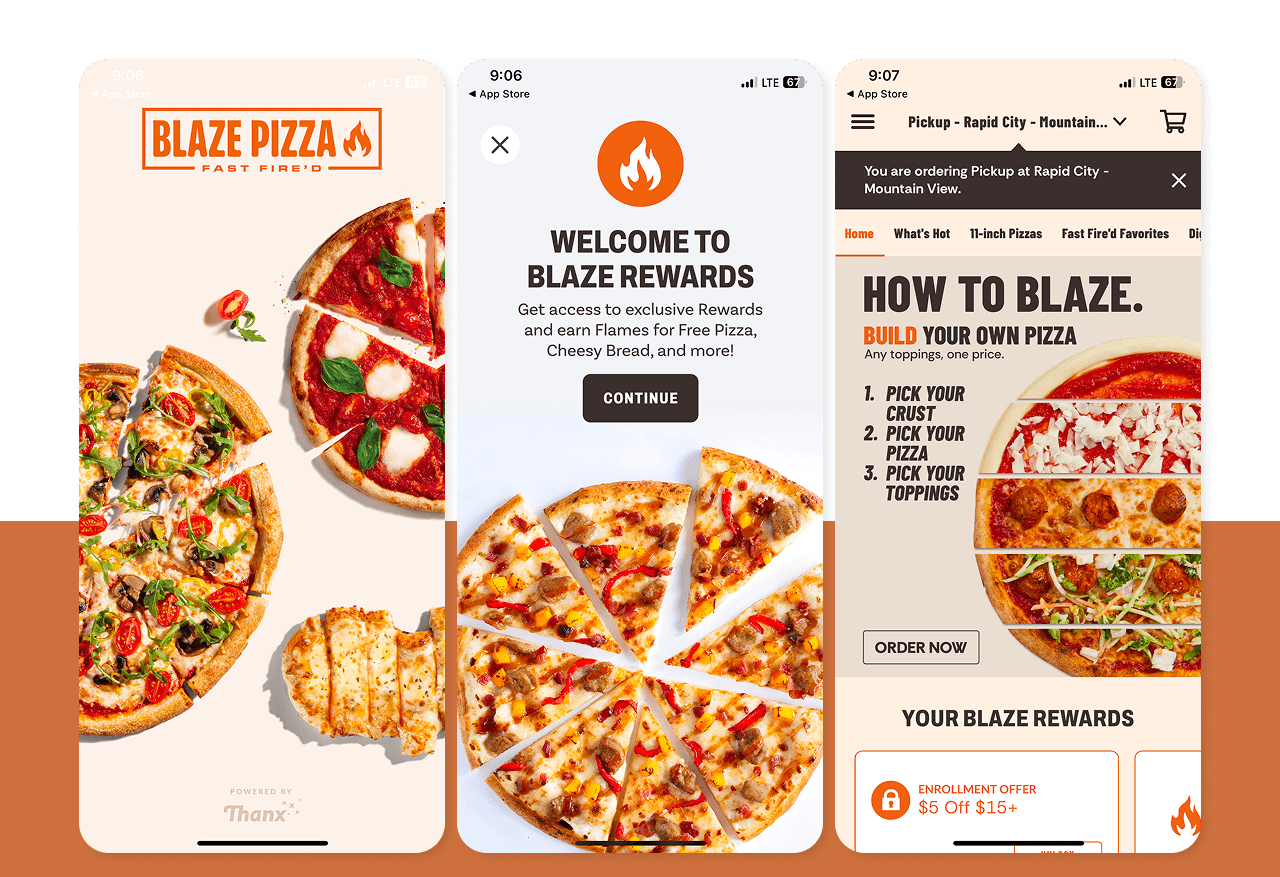
Most brands don't leave their loyalty platform because it's missing features. They leave because they can't use the ones they're already paying for: reports they can't read, changes that take a support ticket and a week, integrations that break with no one to own them. Thanx is built on a different principle, that loyalty should be something your team can see, run, and prove in real time.
That starts with ROI you can surface yourself, self-serve, from day one. With Thanx, you can see what a loyalty guest is actually worth and which campaigns drove incremental visits and spend, rather than existing sales rerouted through an app, so your finance team can stand behind the numbers. It extends to how the day-to-day work gets done. You can build a reward, launch an LTO, or adjust a campaign yourself, with no form to submit, no vendor build to wait on, and no change fees, and lean teams run it without specialized analysts thanks to AI-driven segmentation.
Just as important is who owns the outcome. Loyalty lives inside first-party ordering, so you capture and recognize every guest, not only the ones who remember to identify themselves, and redemption happens right in the checkout flow. Thanx owns our integrations, so when something breaks there is no finger-pointing. The result is a platform built that works with your existing tech stack, with predictable economics across corporate and franchise locations, an interface simple enough for staff to run at the counter, and rewards that protect both margin and brand, whether you are quick-service or full-service. And because Thanx handles member, reward, and history migration and averages 90-day to launch, you can switch without the dip and grow from day one instead of starting over.
If you are weighing your loyalty and guest engagement options, see how Thanx can help: request a demo here.

.png)





.avif)
.avif)