


.avif)

What Is Incentivio: Everything You Should Know
For many multi-unit brands, ordering and loyalty still generate two different views of the same guest. That's a problem when loyalty can shape how restaurants attract repeat visits and where guests ultimately spend their money. According to the National Restaurant Association’s 2026 State of the Restaurant Industry, dining out continues to be essential for 61% of consumers, but it’s often the discounts, daily specials, and loyalty programs that actually get them through the door.
But influencing behavior is easier to see than measuring its value. Without a unified guest record, you cannot tell whether a reward drove an incremental visit or was just a discounted one that was already coming. With 42% of operators reporting their restaurants were not profitable in 2025, that is an expensive blind spot.
Incentivio is one of the platforms built to bring those interactions together. This guide covers what it is, who it serves, what it includes, how it is priced, and what to test before you shortlist it.
What Is Incentivio?
Source: Incentivio’s website homepage snapshot
Incentivio is a guest engagement platform for multi-unit restaurants that brings online ordering, branded mobile apps, loyalty programs, marketing automation, and guest data analytics in one system.
The appeal is consolidation. Instead of managing separate tools, restaurant brands can manage and build a more connected view of all guest interactions through one platform. For brands evaluating how that all-in-one model actually works in practice, it also helps to understand where each company got its start. A platform's origins can offer useful context for where a platform is strongest today and where its focus still sits.
Incentivio began in digital ordering, with loyalty, marketing, and analytics later built around that transaction data. That history still shows up in how the product is organized today: ordering remains the foundation, with loyalty and marketing built around that foundation.
Who Is Incentivio For?
Incentivio is built for growing multi-unit restaurant brands, and the fit is strongest where repeat frequency does the heavy lifting:
- Fast casual. The core segment. Customers include Everbowl, Mahana Fresh, and Cilantro Taco Grill.
- QSR. Counter-service brands where small lifts in check size compound across locations.
- Pizza. A named vertical on Incentivio's site. Bellacino's runs on the platform.
- Coffee and beverage. High-frequency concepts where loyalty lives or dies on visit cadence. Port City Java is the reference customer.
Incentivio also works with franchise brands, though franchisors should look hard at location-level permissions first. More on that below.
The platform does cover a wide product surface area for a company of its size, but the trade-off is depth in any one area. This is the familiar all-in-one versus best-of-breed decision. For brands that prioritize operational efficiency and vendor consolidation, having ordering, loyalty, marketing, and guest data under one contract can be a real advantage. If your program depends on more sophisticated tooling, such as franchise-level permissioning, custom segmentation, or enterprise reporting, test those directly rather than assuming the breadth covers them.
Key Features
Incentivio groups the platform into Commerce, Engagement, and Intelligence.
- Online ordering and mobile apps. Branded web ordering plus white-label iOS and Android apps give brands more control over the digital guest experience.
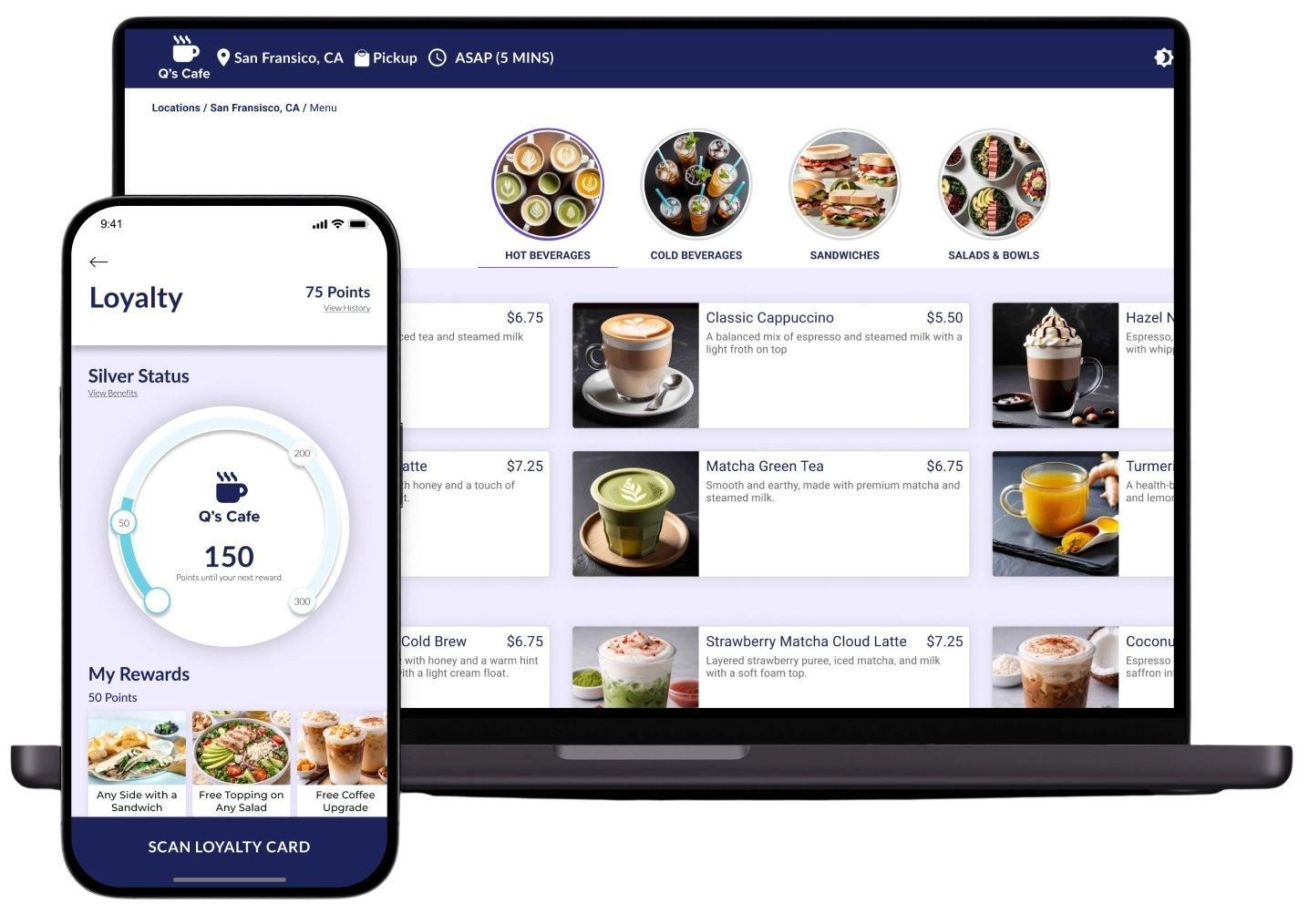
- Incentivio’s Online Ordering App
- Integrated loyalty programs. Configurable programs with discount rewards tied into the ordering experience.
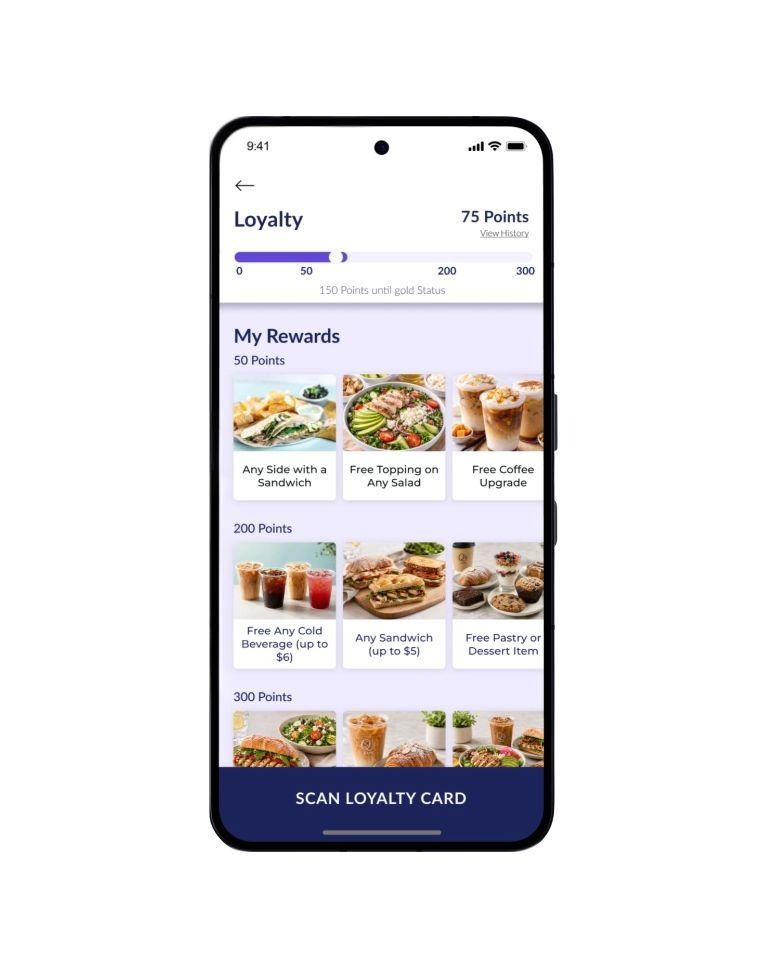
Incentivio Loyalty Program
- Marketing automation. Email, SMS, push, and in-app messaging support personalized marketing campaigns triggered by guest actions, with SMS metered across both marketing and transactional messages. It's worth looking into what counts toward usage, how those costs are calculated, and how they're allocated across locations.
- Churn management. Guest Journey sorts guests into seven fixed stages with Journey Stage and Attrition Risk available for targeting. Scores refresh weekly, per documentation.
- Upsells and Menu Intelligence. Machine learning upsells to lift average check, plus menu analysis scoring link items to loyalty or churn. The model needs 1,000 historical transactions to train, retrains Monday, Wednesday, and Friday, and does not recommend modifiers. Menu Intelligence updates Friday mornings.

Incentivio’s Upsell feature
- Gift cards. Rather than integrating with another third party, Incentivio offers native digital gift cards with balance and liability exports, purchase and reload bonuses, and pooled liability across multiple locations. For brands that don't need a separate stored-value vendor, it's one of the platform's strongest pieces.
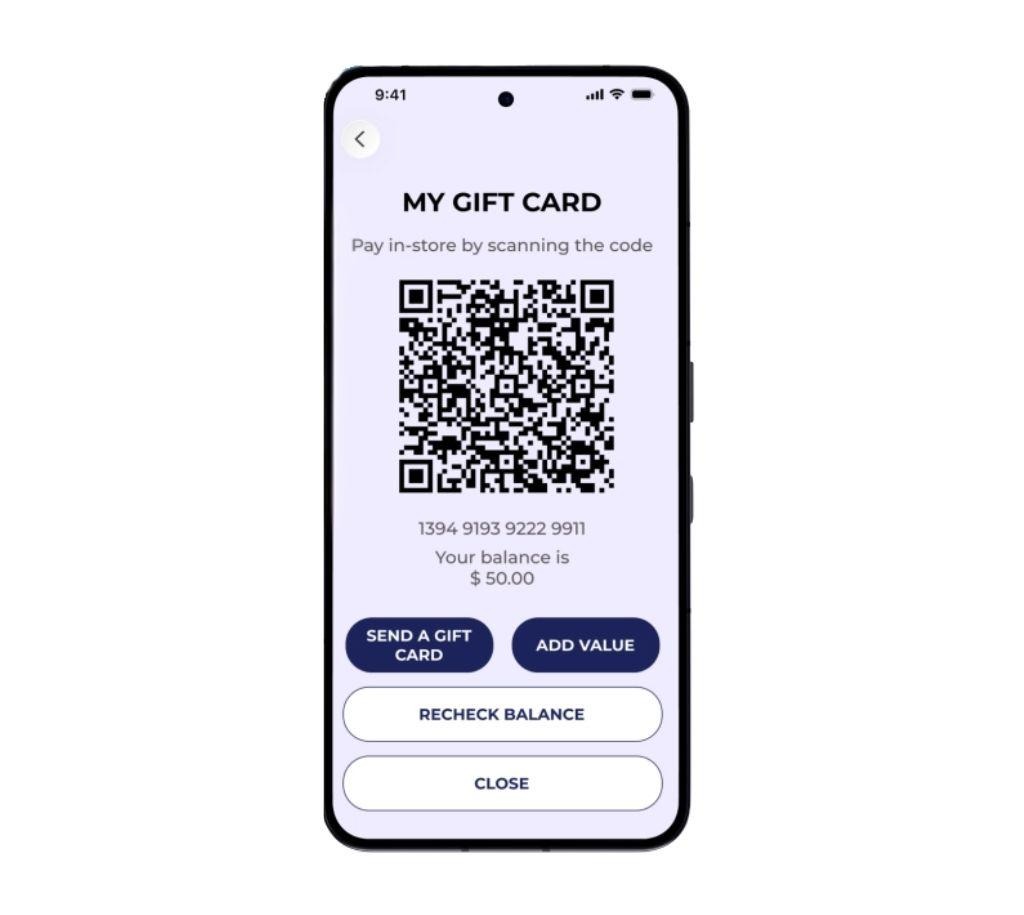
Incentivio’s Gift Card
- Dispatch. Delivery across in-house drivers and third-party providers, including DoorDash and Uber, though third-party delivery orders can only be scheduled 30 days ahead, something to account for if advance ordering is important to your model.

Incentivio’s Dispatch
Two newer products sit on top to expand Incentivio's data and measurement capabilities. Incentivio Connect resolves guest signals from POS, loyalty, app, web, and marketplaces into a single Guest ID and scores each for customer lifetime value, churn risk, and visit frequency.
Loyalty Pulse measures the revenue impact of loyalty through repeat visits, spend, and incremental revenue rather than just points and redemptions.
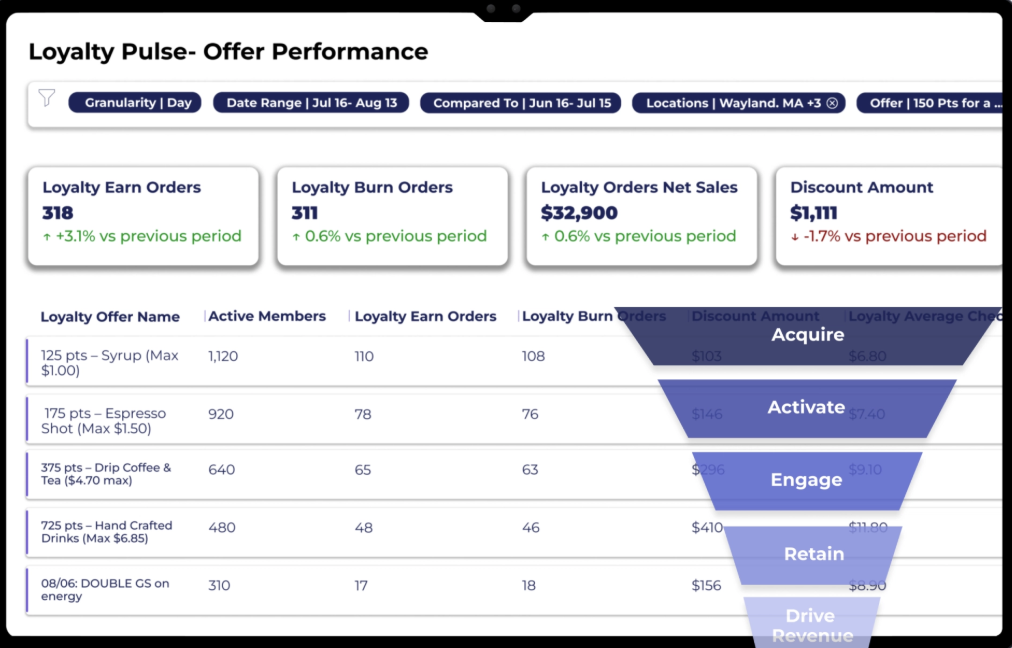
Source: Incentivio’s Loyalty Pulse Reporting Dashboard
Something to keep in mind as you evaluate Incentivio's feature set: An all-in-one platform doesn't necessarily mean an all-in price. While the company doesn't publish standard pricing (every brand receives an individual quote), total costs can include a fixed base subscription plus transaction fees, delivery fees, and metered SMS. As you compare platforms, confirm which capabilities are included in your quote and which costs will scale with usage. See our guide to [Incentivio pricing] for a closer look.
Key Differentiators
Incentivio's positioning rests on claims about structure rather than features:
- One system, one data set: Ordering, loyalty, marketing, and analytics run on shared infrastructure, so a guest's order history, loyalty activity, and campaign response resolve to one profile. For a brand that wants a single contract, that’s a real win. Just be sure to weigh the convenience against the depth of more specialized tools.
- Native gift cards: Incentivio operates its own stored-value solution rather than relying on a third-party integration, a genuine advantage for brands with straightforward gift card needs.
- Audience push into ad platforms. Incentivio routes web and app events to Facebook Pixel, GTM, GTAG, and other destinations through Segment. That's a useful connection to the ad stack, but brands with more complex data requirements should verify what's supported beyond the documented Segment integration.
- Specific ML features rather than an AI platform. Incentivio ships three genuine machine learning capabilities: churn scoring through Guest Journey, item recommendations at checkout, and Menu Intelligence. They are useful, but narrow. Each is a model that produces a score or a list on a batch schedule, and a person still has to act on it. No agent takes action on a brand's behalf, and no agentic product appears in their published documentation.
- Strongest on Toast. Toast coverage is the most complete, and support varies meaningfully across the rest of the list: Square, Oracle MICROS Simphony, Qu, PAR Brink, Revel, and SpotOn. Genius and NCR do not appear on the published integration list. Establish what your specific POS gets before you compare platforms, because in-store loyalty behavior is where the differences concentrate.
- Mid-market rather than enterprise-only: The platform targets growth-stage multi-unit brands, which shapes everything from packaging to implementation scope.
Franchise systems deserve the closest look, because the access and permission layer is thin. Incentivio's documentation notes the customer view "cannot currently display customers only from a particular location," and that offer performance cannot be filtered by location.
In practice, that means a franchisee cannot see their own guests, cannot tell which offers worked in their own market, and cannot send their own offers without corporate coordination. Every operator sees the entire brand's customer base instead. If your model depends on giving franchisees scoped access to their own data, their own reporting, and their own controls, test that before anything else.
Incentivio Online Ordering and Mobile Apps
Ordering is the platform's foundation and the piece most brands want to understand first. Guests order through the restaurant's own website and white-label mobile app, not an app carrying the Incentivio name. Branding, menus, and checkout belong to the restaurant. At checkout, AI upsell recommendations surface add-ons based on what that guest and similar guests ordered before, which drives the platform's average order value claims.
Incentivio's Port City Java case study reports Scan to Pay hit 7% of transactions in the first 30 days and nearly 12% in month two. Every order feeds back into the same guest profile.
One thing to model before you commit: ordering is where their cost structure concentrates. Transaction fees and delivery fees are billed as variable meters on top of the base subscription, so the bill rises with digital order volume. Brands often find the economics comfortable at launch and materially less so once digital becomes a meaningful share of sales.
Incentivio’s Online Ordering App
Incentivio Loyalty and Guest Data Tools
Restaurant loyalty programs integrate earning and redemption directly into the ordering flow, with configurable points programs and rewards ranging from free items to smaller add-ons. Every reward has to be mapped to a discount in the POS, and modifier-level offers do not work in-store on any POS.
The newer guest data layer is weighted toward winback. A seven-stage Guest Journey and Attrition Risk score come pre-computed, which makes lapsing-guest campaigns quick to launch.
Brands that want to build their own audiences should check the fit: the stages are fixed rather than custom, and Incentivio's documentation notes that Journey Stage and Attrition Risk refresh weekly, while behavioral fields such as last purchase date run daily on a two-day delay.
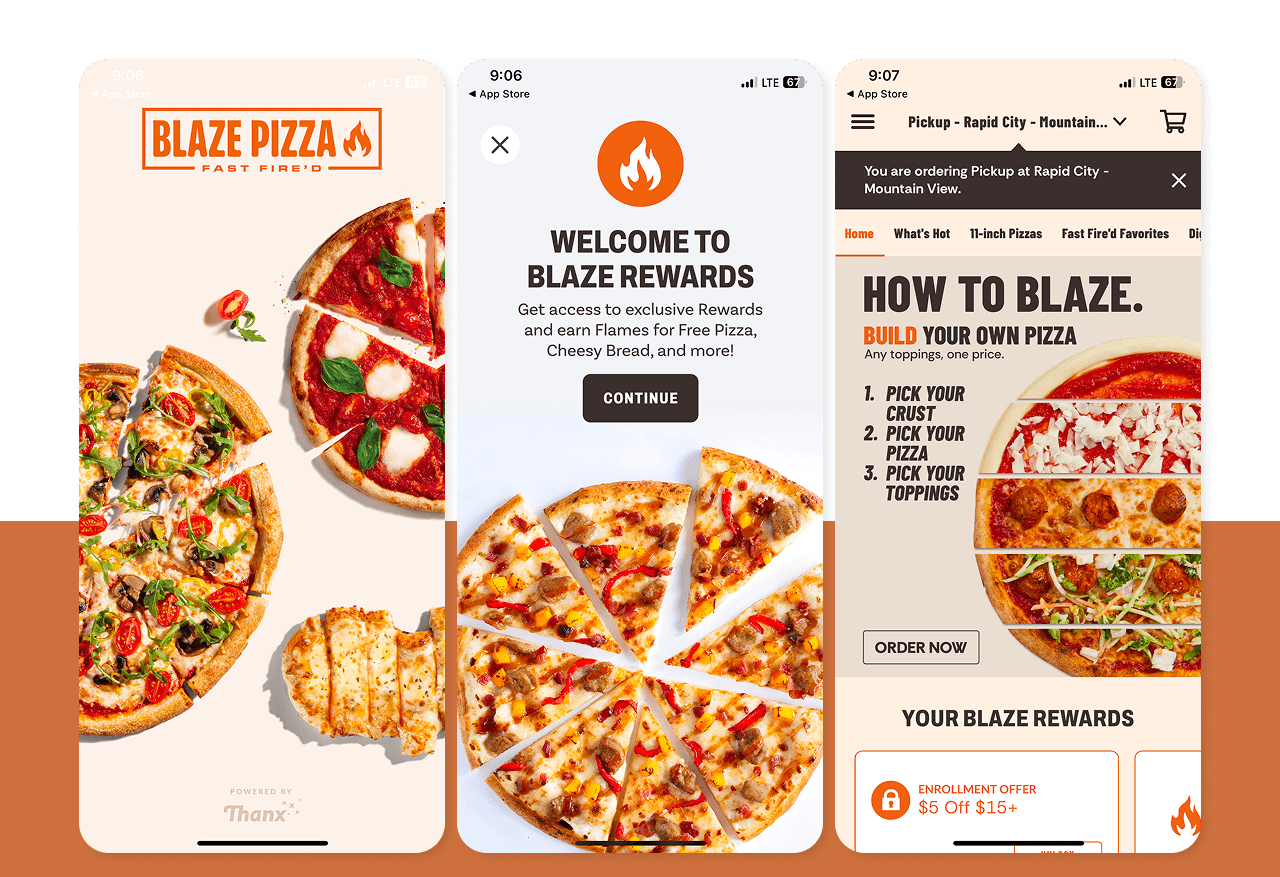
How Thanx Approaches the Same Problem
Instead of starting with the transaction, Thanx started with the guest relationship and built a platform to answer a central question: does our guest engagement program change customer behavior, and does that behavior drive business outcomes?
Where Incentivio's all-in-one argument sounds most compelling is ordering. Incentivio's pitch is one vendor, but in practice, it still has to sit on top of your POS.
Thanx also directly connects to the point of sale like Toast and Square, but it doesn’t require ordering to become part of the loyalty-platform decision. Brands already using platforms like Olo or Deliverect can keep their existing ordering stack and layer Thanx around it.
Where a brand does run ordering through Thanx on Toast, the menu is pulled directly from the POS rather than through a middleware layer. Items, prices, and stock status stay in sync in real time, so a guest is not ordering something that sold out an hour ago and the operations team is not reconciling two menus. Any platform that keeps its own copy of the menu has to sync it, and the lag between the two is where operational problems start.
From there, Thanx goes deeper on the tools that actually move revenue.
- You can prove a campaign worked. Built-in A/B testing and reporting show you exactly how many guests purchased, what they spent, what the campaign cost, and ROAS by variant, while control groups help separate the guests who responded from the ones who were coming anyway. Most platforms in this category report activity. This reports outcomes.
- You can see what the program costs. Thanx publishes an Effective Discount Rate report with cost per redemption on every reward and in aggregate, so there is one number for what the program gives away as a share of the revenue it drives, and you can watch it move quarter over quarter. Without that number, discount spend drifts upward, and nobody notices.
- The guest is recognized in the moment. Points and progress post immediately, automations run continuously rather than on an overnight batch, and reporting is real-time. Instead of going quiet after a purchase while data catches up, the program can use that interaction to inform what happens next.
- Segmentation has no ceiling. SegmentAI builds an audience from a plain-English description across more than 400 attributes, including item and modifier purchases, cart events, and sentiment. "Guests who ordered a chicken bowl with guac but haven't been back in 30 days, excluding anyone who came in this week" is a sentence you type, not a ticket you file.
- Rewards do not have to cost margin. Brands can use Hidden Menus and Access Passes to let loyalty members spend points on secret items, experiences, or status perks instead of training guests to wait for the next discount. Modifier rewards like free guacamole provide another way to drive frequency at the cost of an add-on rather than an entrée.
- The app is a marketing channel. A self-service CMS handles navigation, homepage layout, carousels, and content blocks, published in minutes with no developer and no change fees. Content blocks can be targeted by segment, so a seasonal LTO reaches the guests it is meant for.
- Pricing is flat. Per location, all in, no transaction meters. Your cost does not rise because your digital program worked.
Pokeworks put the platform to the test, growing loyalty signups fourfold and pushing loyalty into double-digit share of sales within seven months. Implementations average around 90 days with no hardware.
And the direction of travel is toward doing more of this work for you. SegmentAI was the first phase, taking the manual build out of audience creation. Next are agents that act on your data when you are not paying attention, starting with RecoveryAI.
If you are looking to prove that lift, request a demo and see what it looks like against your own numbers.

.png)





.avif)
.avif)