

.avif)

Top Incentivio Competitors and Alternatives in 2026
Incentivio makes an appealing case for putting online ordering, loyalty, marketing, and guest data under one roof. But once you start comparing it against other guest engagement platforms, the decision gets more complicated.
For some brands, consolidating more of the tech stack is the priority. Others already like their POS and ordering setup and want a loyalty platform that can sit on top of it. And for larger brands, the deciding factor may be segmentation, enterprise scale, catering, or the ability to measure incremental revenue.
That's why an Incentivio alternative isn't necessarily a like-for-like replacement. The right choice depends on the problem you're trying to solve.
This guide compares six of the top Incentivio competitors in 2026, where each one stands out, and what to consider as you narrow your shortlist.
Our Methodology & Criteria for Selecting the Best Incentivio Alternative
We built this list around one question: which platforms actually fix the problems that send brands looking past Incentivio in the first place. So we started with the most common failures that show up with an all-in-one solution (flat enrollment, unidentified in-store guests, and loyalty that cannot prove its revenue impact), then worked backward to the capabilities that solve them.
To assess each platform, we looked at product documentation, pricing where we could find it, customer case studies, and reviews on G2, Capterra, and TrustRadius. When a result comes directly from the vendor, we'll tell you. We also checked those claims against what restaurant brands are actually reporting about the platforms.
We also put more weight on recent feedback from restaurant operators than older reviews or feedback from other industries.
From there, we measured each option against the criteria that matter most for a brand trying to make loyalty pay:
- Loyalty that shows what it costs and what it generates. Look beyond points issued and redemptions to whether you can track program costs, measure campaign lift, and show how much incremental revenue loyalty actually drove.
- Marketing that can get more sophisticated as you grow. Segmentation, automation, testing, and personalization should expand with your strategy instead of stopping at a fixed set of targeting rules.
- Guest data that keeps up with the guest. Points, offers, customer records, and reporting should reflect what just happened, not what happened yesterday or two days ago.
- Consistent loyalty across your existing restaurant stack. An integration logo only tells you that two systems connect. We looked at whether the loyalty experience and functionality stay consistent across POS and ordering providers.
- Rewards that aren't limited to discounts. Dollar-off and percentage-off offers have their place, but a loyalty platform should give brands other ways to create value without taking margin off every check.
- Controls that hold up as the brand scales. We looked at location-level visibility, franchise controls, marketer self-service, and costs that can become harder to manage as the program grows.
The result is not a ranking of which platform packs in the most features. It is an assessment of which ones best close the gap between running a loyalty program and proving it drove revenue.
Best Incentivio Alternatives
- Thanx for measuring loyalty impact on revenue
- Lunchbox for enterprise catering and ordering
- PAR Engagement (Punchh) for large enterprise chains
- Paytronix for the broadest all-in-one suite
- Como for a branded app and gamified loyalty on a smaller budget
- Toast Loyalty for brands already running Toast POS
1. Thanx
Best for: regional and national restaurant brands that need loyalty to produce measurable, profitable revenue rather than sign-up counts.
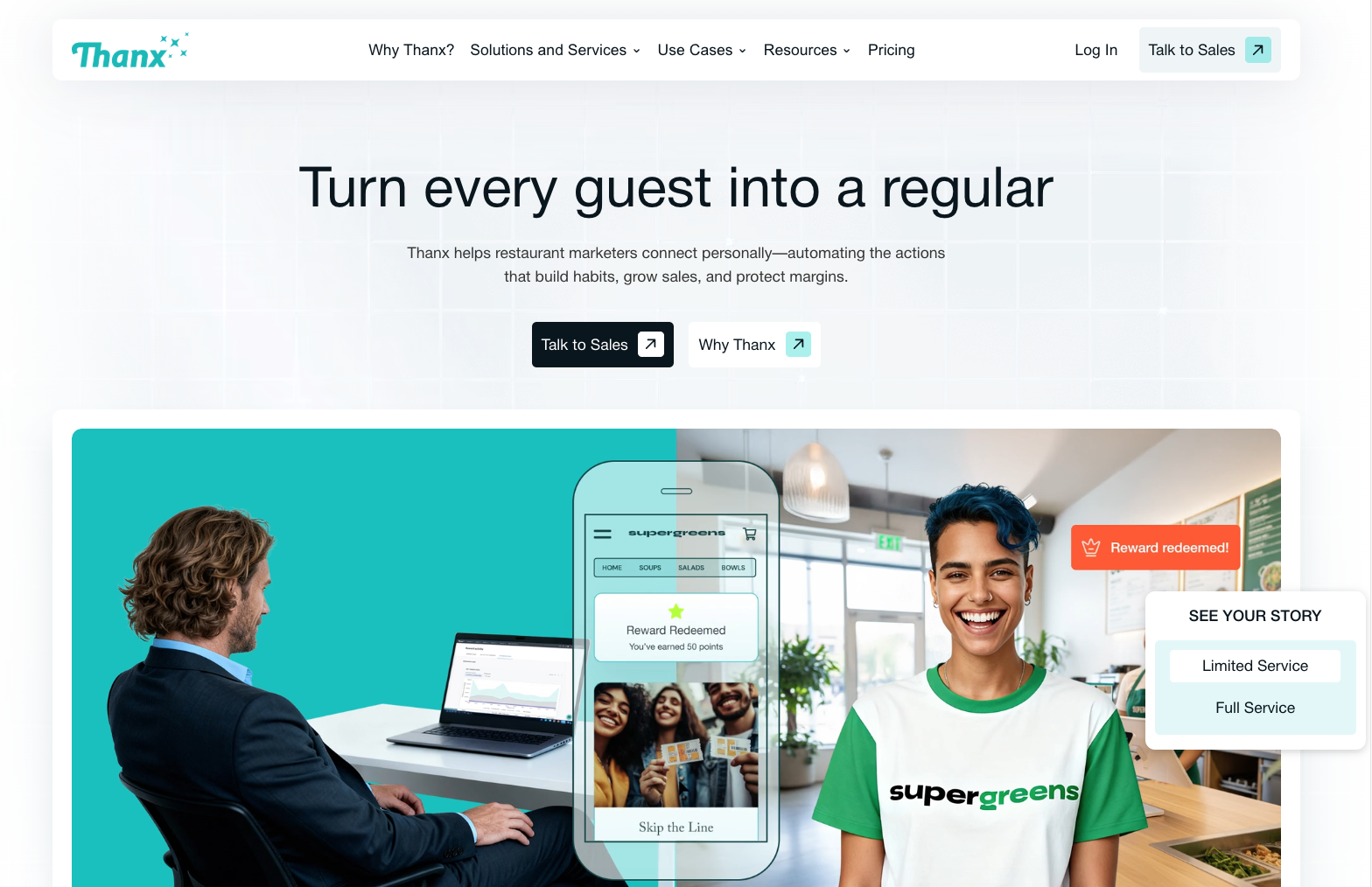
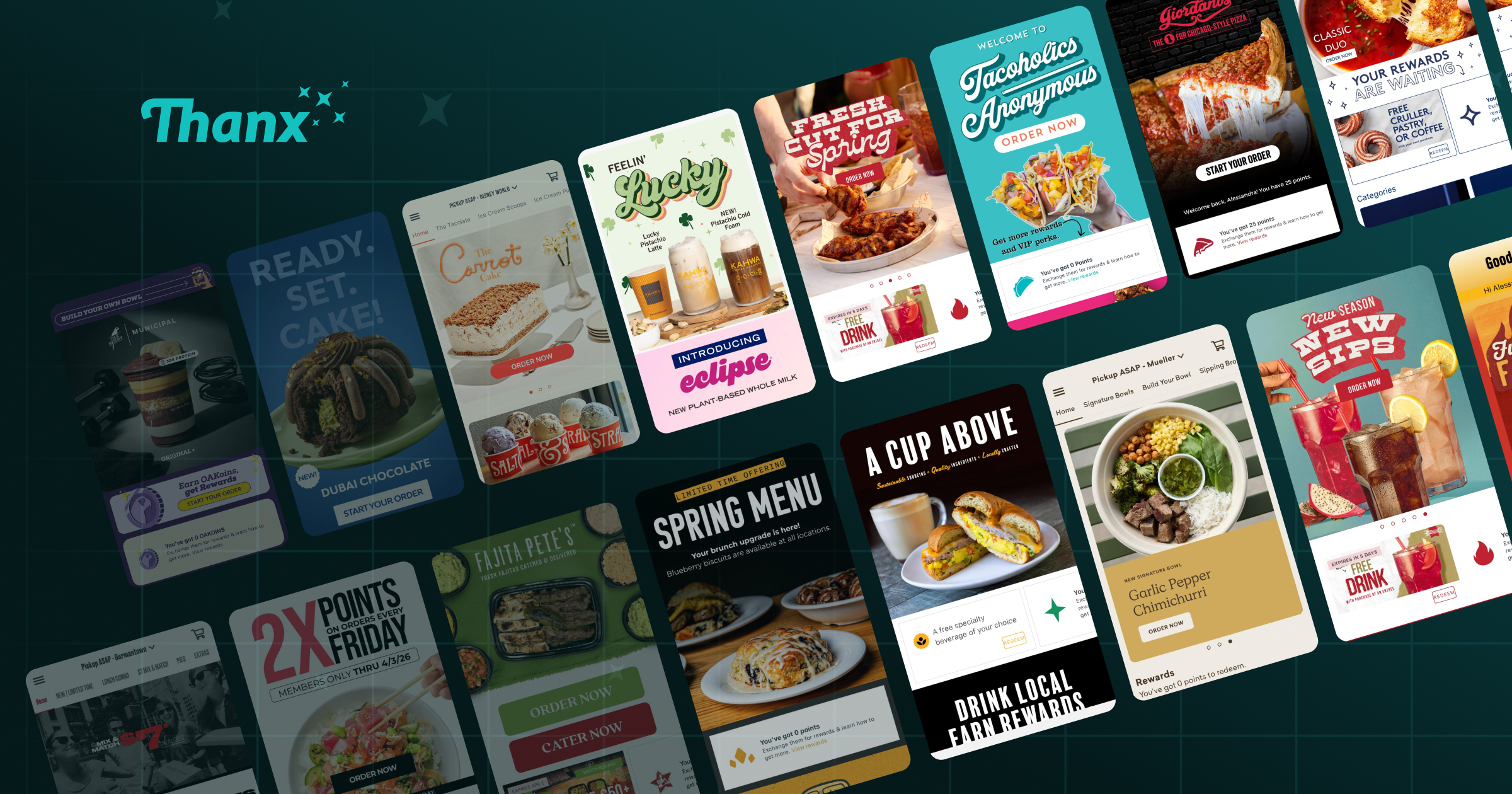
Source: Thanx website homepage snapshot
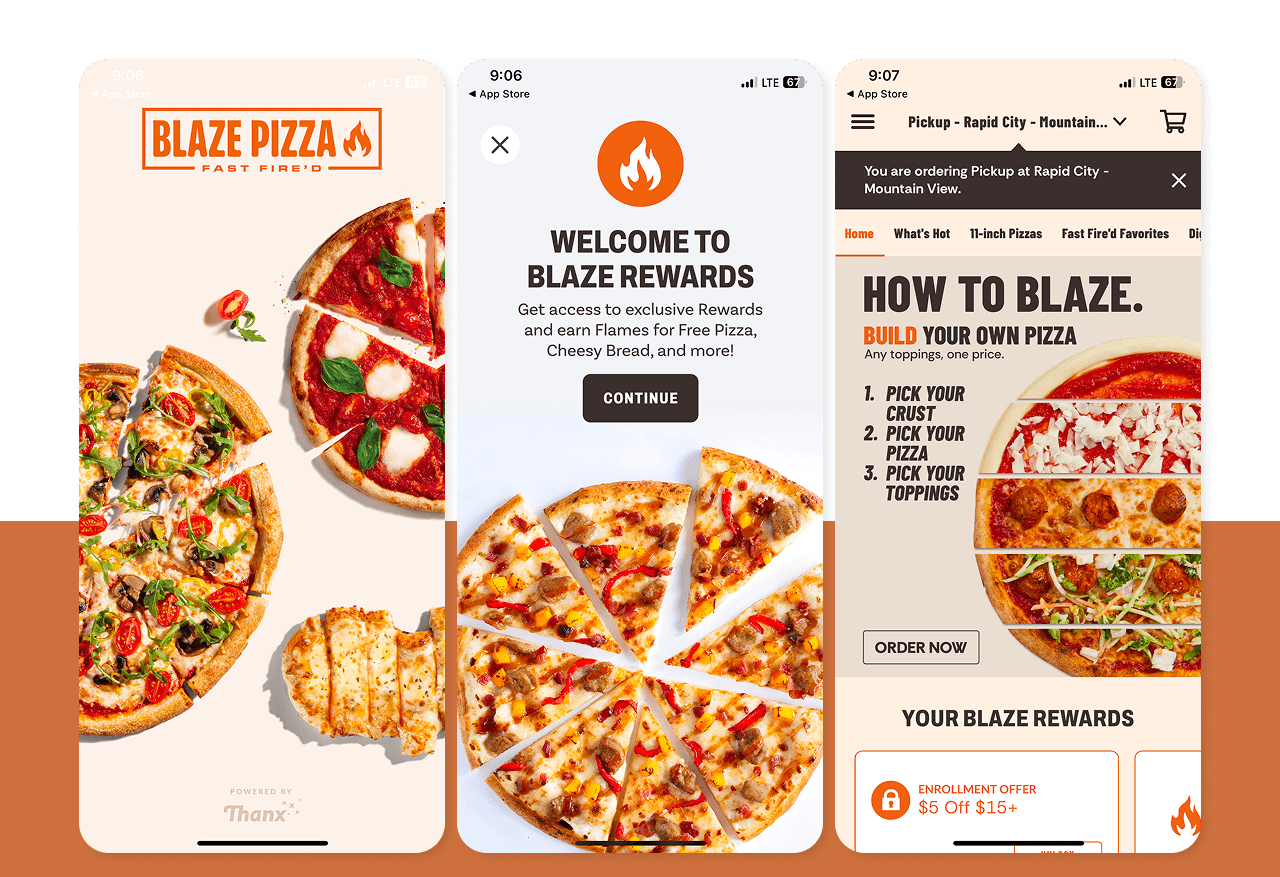
Thanx is a loyalty and guest engagement platform for regional and national restaurant brands. Blaze Pizza migrated more than five million rewards members onto it when relaunching its app and program.
Key Features and Differentiators
- Loyalty that reflects back to the guest in the moment: Points, progress, and rewards update immediately, automations run continuously, and reporting is real time. Incentivio's loyalty engine runs on an overnight batch, so points post the next day, post-purchase offers send overnight, sales reporting runs two days behind, and the customer record a service agent sees on a live call is two days stale.
- Richer guest data and segmentation: Frictionless capture produces 57% more purchase data than standard programs, with segmentation that targets guests by real behavior rather than broad lists.
- An open data platform that fits your stack: Open APIs and 60+ pre-built integrations, a direct Square POS connection with no middleware, a certified Toast partnership, and a March 2026 Deliverect partnership, with access to Deliverect's 1,000+ integration network.
- Margin-friendly offer management: Secret menus, access passes, and modifier rewards replace blanket offers, cutting effective discount rates from an industry benchmark of roughly 10% down to about 2.4% on average, tracked in a dedicated Effective Discount Rate report with cost-per-redemption on every reward.
- Provable incrementality in reporting: A/B testing is a step in campaign creation, with up to four variants, one of which can be a true control-group holdout, and reporting shows revenue and ROAS by variant.
- First-party ordering designed to convert: App conversion rates of 95% and an average 38% lift in repeat visits. 90% of Thanx customers grew first-party digital sales in year one, half by 50% or more.
- Fast, low-lift implementation: A no-code CMS for unlimited app updates without developers or fees, and launches averaging about 90 days versus the 9 to 12 months common elsewhere.
[supporting screenshot]
Pros
- Guests can join and earn at the counter, so enrollment is not capped by app adoption.
- Modernizes loyalty without changing ordering provider or POS, removing the biggest source of transition risk.
- Ties campaigns to incremental revenue with control groups.
- Members transfer with their balances, existing app rolled over, no hardware to install.
Want to see it against your own numbers? Request a demo.
Pricing
Thanx does not publish pricing. Pricing is flat and per location, covering the platform and every improvement shipped, with no variable transaction or messaging fees. The quote depends on location count and which products you deploy across loyalty, CRM, and digital ordering.
2. Lunchbox
Best for: enterprise brands that want app and web ordering, catering, and loyalty bundled into one suite.
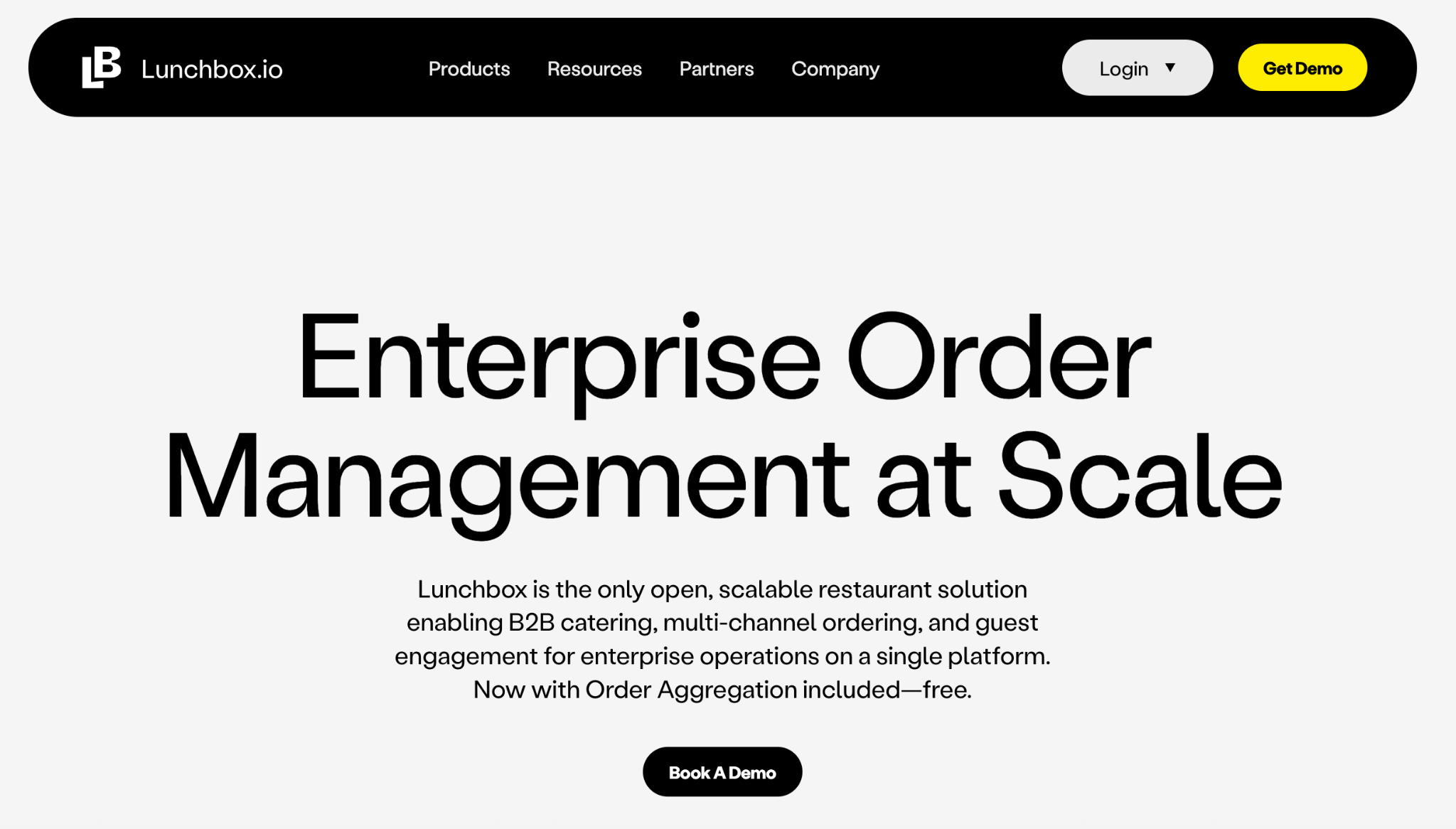
Source: Lunchbox website homepage snapshot
Lunchbox is the closest structural analog to Incentivio: an enterprise platform combining app and web ordering, catering, loyalty, marketing, and third-party order aggregation. Lunchbox reports 5,000+ locations, including Firehouse Subs, Pei Wei, and Clean Juice. As with Incentivio, loyalty sits inside an ordering suite.
Key Features and Differentiators
- Native app and web ordering: First-party ordering across branded mobile and web channels the brand owns. The ordering and app UX is a genuine strength and is widely regarded as one of the best-designed in the category.
- Enterprise catering operations: This is more than a catering menu. Lunchbox ships a catering editor, calendar, production sheets, pack lists, and call-center quoting, so it runs catering operations rather than just taking catering orders.
- App-first points loyalty: Members earn by opening the app and scanning a QR code at the counter, with a second, separate scan for Scan to Pay, since a single QR code for both is not supported. There is no in-store enrollment on the POS, a kiosk, or a guest-facing display, so every new member has to download the app first. Lunchbox's own help center states that loyalty registration is not available directly on the Toast POS. Reward types are coupons, credits, and points, and points conversion can vary by tier.
- Deep coupon engine: Coupon configuration is richer than most loyalty vendors offer, including unique discount codes and bundle promotions, though setup for most coupon and program changes routes through Lunchbox Support or a CSM rather than a self-serve dashboard.
- White-labeled marketing CRM: Email and SMS run on Customer.io, white-labeled under the Lunchbox brand, with a Twilio account the merchant contracts and pays for separately. Reporting on loyalty performance sits apart from ordering and marketing data, and there is no A/B testing, control group, or holdout capability documented for proving a promotion drove incremental visits.
- Third-party aggregation and call center: Marketplace orders pulled into one system with automated dispute handling, plus a staffed call center, house accounts, and group ordering that few loyalty-first vendors match.
Pros
- Strong catering operations tooling, with production sheets and pack lists that ops teams actually use.
- Staffed call center, marketplace aggregation, house accounts, and group ordering in one platform.
- Tiered earn rates, with points conversion that can vary by tier.
- Well-regarded ordering and app UX.
- Open API with 100+ integrations.
Pricing
Not published. Quoted per brand by location and modules, typically on two- or three-year terms, so confirm the notice period and whether the contract includes an opt-out clause before signing.
The software subscription is only one layer of the total cost. Budget for per-message email and SMS fees, which merchants report can rival or exceed the subscription itself; a separate Twilio account for the Customer.io-based CRM; and payment processing through Finix at roughly 2% plus $0.20 per transaction, which works out to about 3.1% effective on a $16 ticket versus 2.1% to 2.2% on standard Toast processing.
In franchise systems, that processing cost is typically borne by franchisees rather than corporate. Bringing your own loyalty provider such as Punchh or Paytronix requires a separate contract and its own fees.
As one illustration, a 12-location brand reported roughly $3,600 a month in software plus $3,000 to $6,000 a month in messaging fees, for an all-in cost near $17,000 a month before accounting for the cost of the rewards themselves.
Because every Lunchbox reward is a discount, credit, or points, effective loyalty discount rates on the platform tend to run 10% to 12%, which on most brands' loyalty volume is a larger line item than the platform fees. Model both before comparing against any competitor's quote.
3. PAR Engagement (Punchh)
Best for: large enterprise chains that need loyalty and segmentation proven at the top of the market.
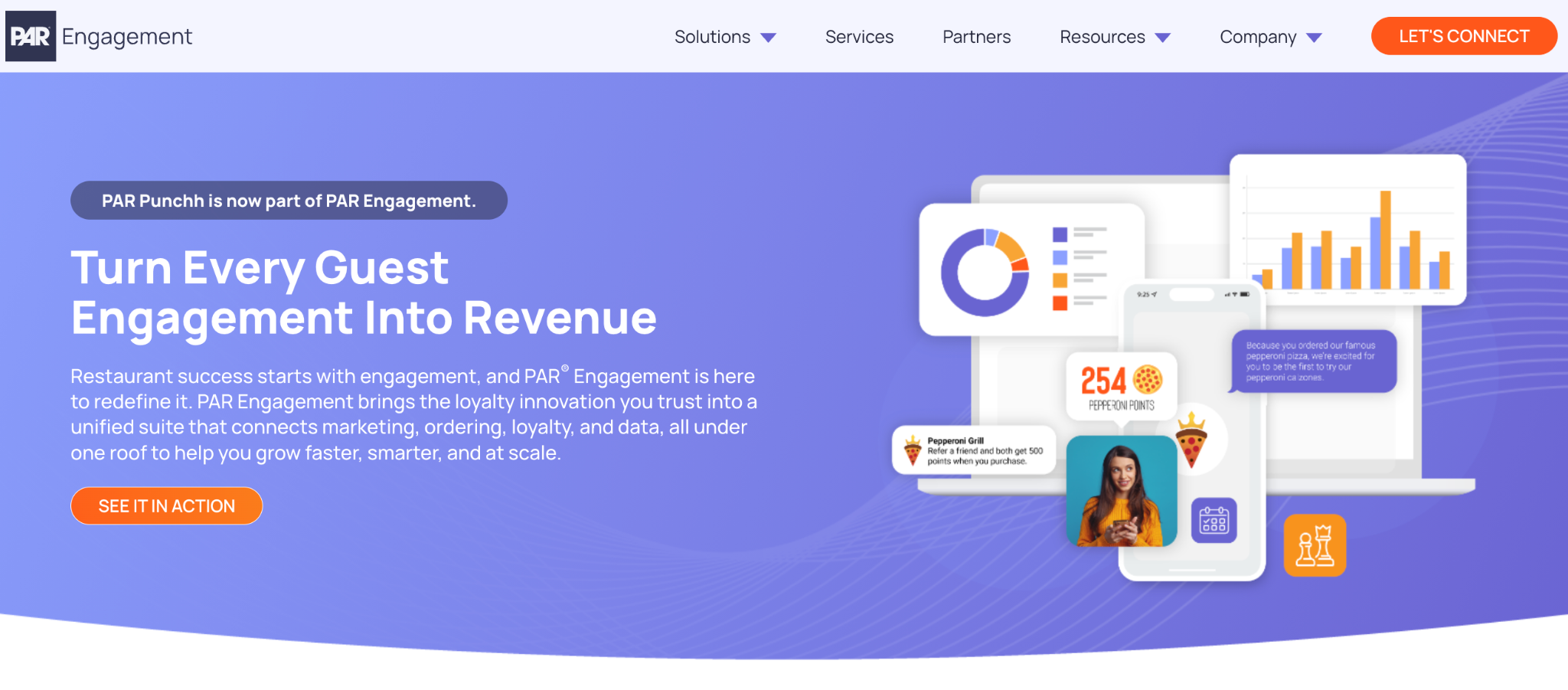
Source: PAR Punchh website homepage snapshot
PAR Engagement (Punchh) is enterprise loyalty at the top of the market, part of PAR Technology's engagement suite, powering loyalty for 34 of the top 100 US restaurant brands and more than 275 brands across 89,000 locations, by PAR's own count.
Key Features and Differentiators
- Multiple ways to earn: Points can be issued for item purchases, referrals, profile completion, and challenge completion. Accrual can be gated by item, check total, hour, or weekday, and earn rates can differ by tier.
- Paid memberships: Priced recurring plans with validity periods, auto-renewal, sales tax by state and location, configurable cancellation reasons, and dedicated membership analytics.
- Tier Boost: Temporarily gifts a guest a higher tier for a set window without reducing their earned status.
- Digital Stored Value and Loyalty Pay: Gift card purchase, sharing, transfer, consolidation, and auto-reload, plus loyalty and payment in a single scan or tap at checkout through Loyalty Pay (formerly Punchh Wallet).
- Swag Management: Physical merchandise rewards with SKUs, size variants, global inventory, and shipping handled in the platform.
- Enterprise controls: A configurable fraud rules engine covering guests and employees, reports automatically scoped to each user's location access, and a Liability Report that retains point liability across program restructures.
Pros
- Proven at scale with blue-chip chains, and one of the longest-established enterprise loyalty platforms in the category.
- The broadest earning and reward mechanics on this list, spanning item-level earning, memberships, stored value, and merchandise.
- Gift cards and stored value run inside PAR's own platform rather than through a separate gift card vendor, which removes a vendor relationship and a reconciliation problem.
- PAR Technology also owns the Brink POS, giving Brink brands a single-vendor path for POS and loyalty.
Pricing
Enterprise-only and not published. PAR sells three tiered packages: Essentials at the entry level and Premium in the middle, which adds gamification, Loyalty Pay, and stored value. One 2026 operator quote we reviewed put Premium at roughly $500 per location per month, including email fees.
Treat that as directional rather than a rate card. Per PAR's own documentation, Smart Passes, PAR Games, Challenges, Surveys, Coupons and Promos, Digital Stored Value with Gift Cards, Memberships, Loyalty Pay, Data Pipeline, Webhooks, and eClub are each available for an additional cost, and accessing your own data through Data Pipeline is billed separately.
App updates are charged monthly and, in contracts we have seen, capped at two per year, with support and uptime sold as a paid tier. Contracts typically run three years with a 90-day non-renewal notice window, so track the notice deadline rather than the renewal date.
Many brands also pair PAR with a UX agency for custom app work, which adds to total cost.
4. Paytronix
Best for: full-service restaurant and convenience store brands that want the broadest all-in-one product footprint.
Source: Paytronix website homepage snapshot
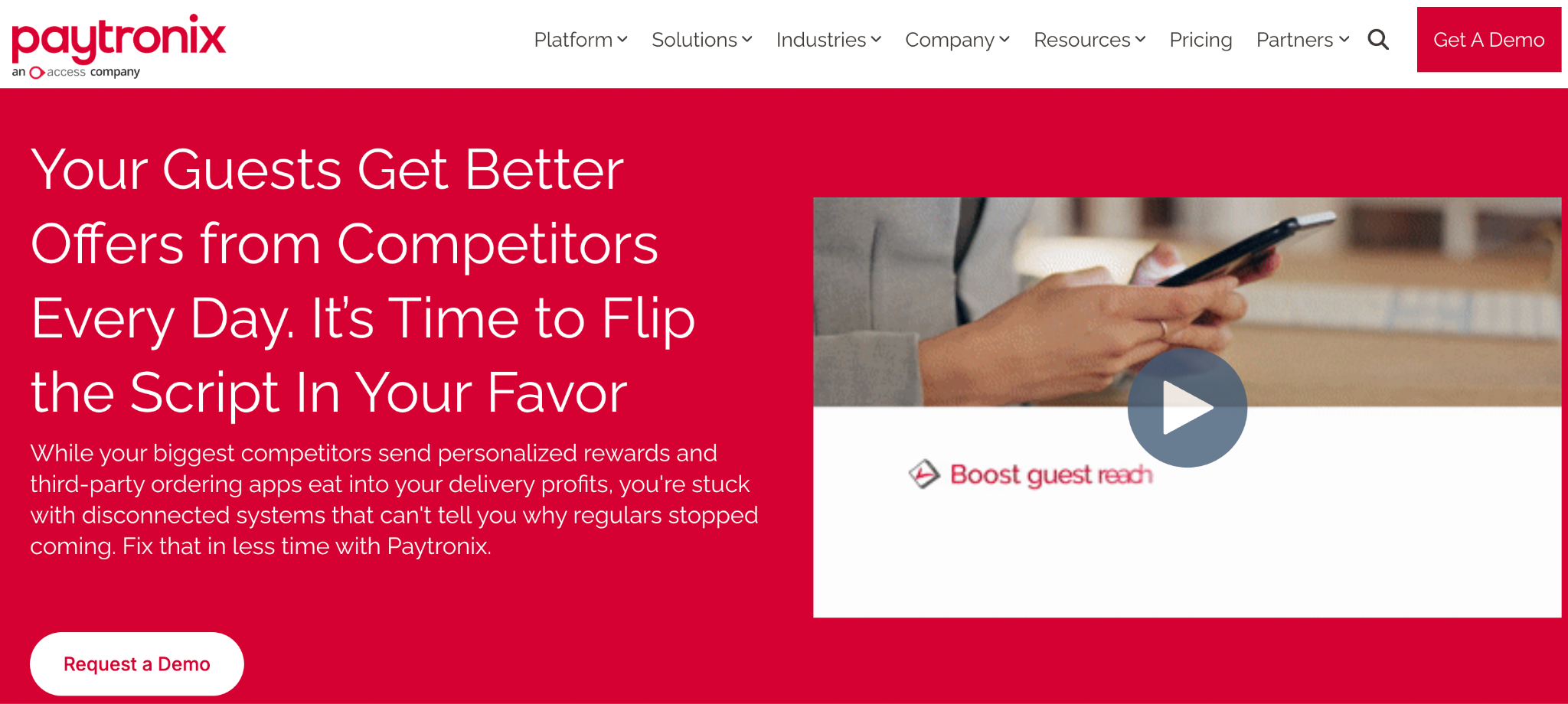
Paytronix is a mature suite serving 1,800+ restaurant and convenience store brands across roughly 50,000 sites, and has been an Access Group company since 2024.
Key Features and Differentiators
- Full product suite: Loyalty, online ordering, gift cards, catering, kiosks, and payments in a single platform.
- Gift cards and stored value: The platform’s strongest area and the most common entry point. Gift card management is built for franchise accounting, with back-end logic for reconciling balances across franchisee-owned locations that few other providers replicate.
- Subscriptions: Built-in recurring membership programs to drive predictable repeat visits.
- 450+ integrations: One of the widest integration libraries in the category. In a Toast and Olo stack, loyalty runs as a three-vendor setup: brands report configuring discounts separately in each system, and online BOGO offers apply as percentage discounts across items rather than true buy-one-get-one logic.
Pros
- More than 20 years in market, with long-standing relationships across major full-service and casual dining chains.
- Unusually broad product footprint, with a loyalty feature set deep enough for complex program structures. Plan for the operating model that comes with it: brands report that creating a new reward runs through a support ticket (wallet name, PLU, comp ID), followed by GUID mapping and testing across Toast and Olo, with a lead time of about a week, and that account-level settings changes also go through support. Build that into LTO and seasonal campaign calendars.
- Gift card and franchise accounting depth that is hard to find elsewhere. The flip side is that migrating a franchise gift card program off the platform means untangling accounting logic no other provider handles the same way, so understand the exit path before signing.
- Strong c-store credentials alongside restaurants.
Pricing
Not published. Enterprise positioning, typically priced per location. Budget beyond the license: brands cite change fees in the $40,000 to $50,000 range for program modifications; analytics questions beyond the standard dashboards (such as what a loyalty member is actually worth) are often handled as a separately paid engagement with the Paytronix analytics team, and behavioral segmentation commonly requires a third-party CDP on top.
Quarterly business reviews are not included at every account tier. Total cost of ownership is the platform fee plus change fees, internal specialist time, and any external data tooling.
5. Como
Best for: small and mid-size restaurant groups that want a branded app and gamified loyalty without enterprise pricing or an enterprise implementation.
Source: Como website homepage snapshot
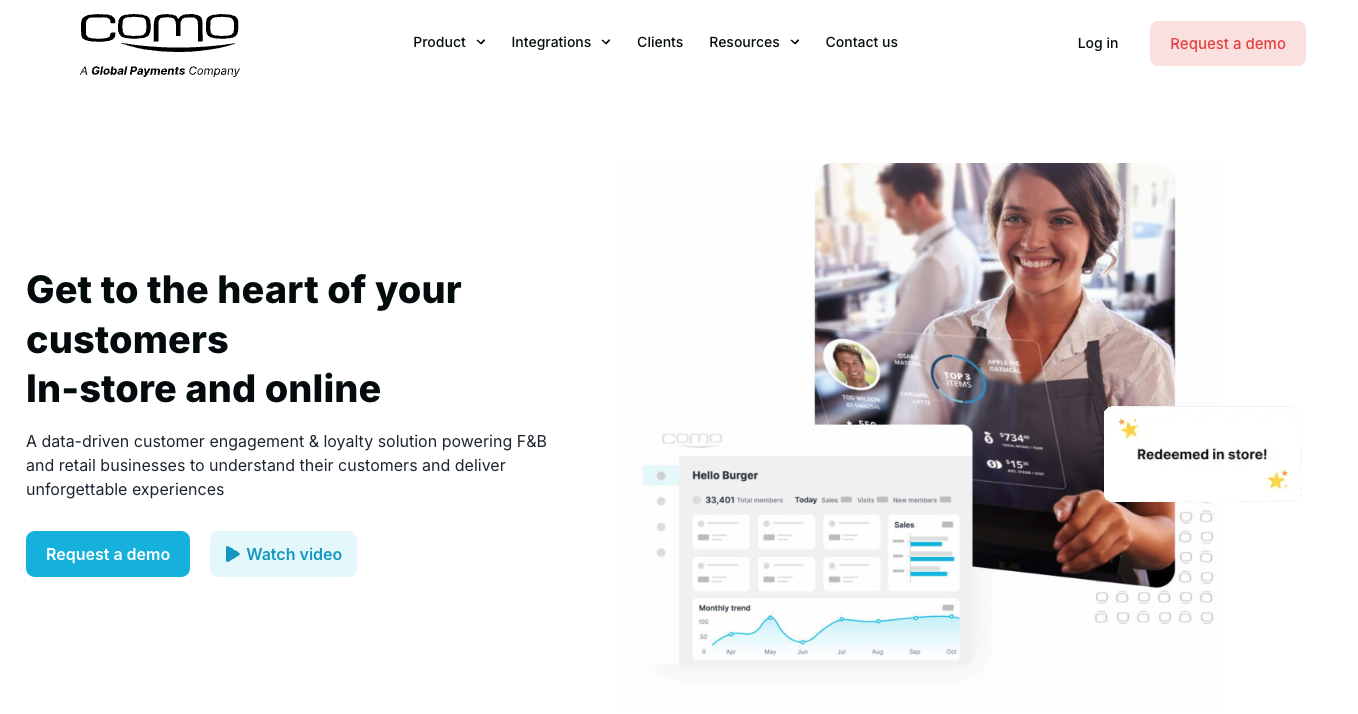
Como (sold as Como Sense) is a customer engagement and loyalty platform for food and beverage brands, reaching most of its customers through POS partnerships rather than direct enterprise sales.
Key Features and Differentiators
- POS-led data capture: Loyalty runs off transaction data pulled from the POS rather than requiring a separate ordering stack. Most brands reach Como as a white-labeled add-on through a POS partner rather than through a direct contract.
- Branded mobile app: A white-labeled app carrying loyalty, offers, and messaging under the brand's own identity.
- Gamified promotions: Mechanics like spin-to-win and cashback, aimed at engagement beyond straight discounting.
- Marketing automation and omnichannel messaging: Targeted campaigns, birthday and lapsed-guest triggers, and analytics in a single dashboard. Segmentation and automation cover the basics, and reporting tracks redemptions and activity rather than incremental revenue: there is no control-group measurement of program lift.
- Multi-industry footprint: Also used across retail, health and beauty, entertainment, and fitness, which matters for operators running mixed concepts.
Pros
- Lowest published entry price of any platform on this list.
- Broad POS partner coverage, including legacy systems many modern platforms have dropped.
- Frequently bundled into a POS or tech-stack deal, so the loyalty line item can be free or close to it.
- International footprint suits brands operating across multiple countries.
Pricing
Not published on Como's site. Capterra lists Como Sense starting at $59 per month, with an overall rating of 3.9 from 11 reviews.
Treat that as a floor, since real cost is quoted per location and varies by whether you buy direct or through a POS partner. Because Como is often folded into the POS contract, the standalone cost can land near zero.
The trade-off is that the budget tier buys redemption tracking rather than lift measurement, so brands that later need to prove program ROI should budget for that as a gap rather than an included feature.
6. Toast Loyalty
Best for: brands already running Toast POS that want a simple points program bundled into the system they already use, with no second vendor to manage.
Source: Toast Loyalty website homepage snapshot
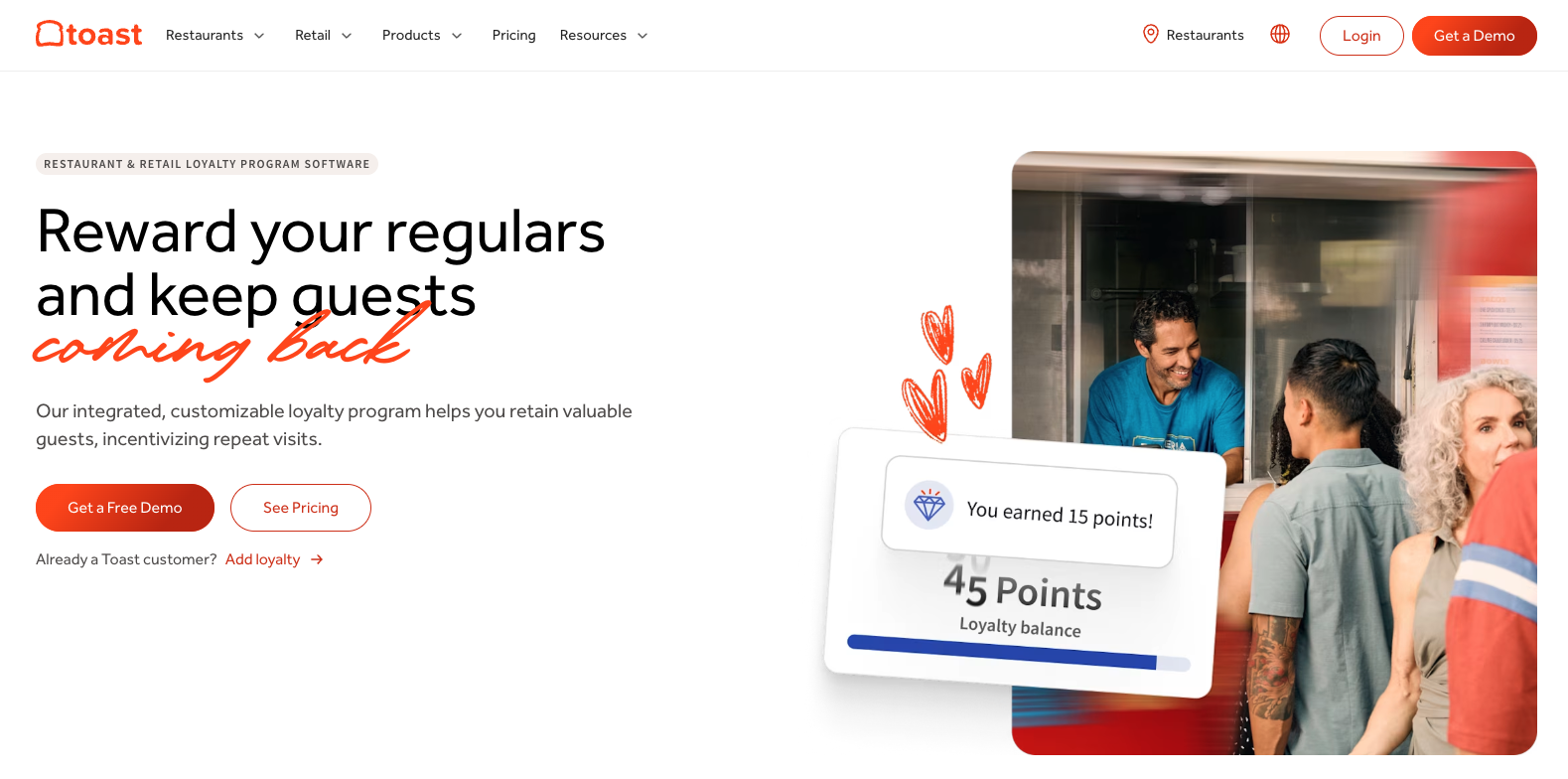
Toast Loyalty is loyalty built directly into the Toast POS ecosystem rather than a standalone platform. Guests enroll by entering a phone number or email at checkout on a Toast terminal or Toast Go handheld, and it only works with Toast POS.
Key Features and Differentiators
- Enrollment at the terminal: Guests join at checkout with a phone number or email, with no app download required.
- Four-threshold points ladder: Up to four reward thresholds, each redeemed as a cash discount or a free item. There are no status tiers, and Toast's own documentation states the program does not support charging guests a fee for access, so paid memberships are not an option.
- Marketing Essentials automations: Nine prebuilt email templates and five SMS automations, each campaign running on a single channel and sent as a daily batch. One 28-day frequency cap governs every automation, which Toast's own worked example puts at roughly 13 automated touches per guest per year.
- Guestbook segmentation: One-time emails can target by recency, order count, average spend, order source, and loyalty status. SMS is limited to location plus three fixed audiences (new signups, lapsed guests, big spenders), and neither channel segments at the item or modifier level.
- Native to the Toast ecosystem: Points accrue in Toast Mobile Order & Pay, mobile payments, and the Local by Toast app without integration work, though free-item rewards cannot yet be redeemed on those surfaces. Toast has also released a branded mobile app option, and marketing email sends from a Toast-controlled address rather than your own domain.
- Last-touch reporting: Campaign attribution uses a 14-day last-touch window with no control group, and the "loyalty sales lift" metric is calculated as sales divided by discounts redeemed.
Pros
- Zero integration lift for brands already on Toast, and $0 incremental cost if you already pay for the Marketing Essentials suite.
- One vendor and one bill across POS, payments, and loyalty.
- Staff is already trained on the terminal, so in-store enrollment needs no new process.
- Easy to layer on top of later: Toast's partner ecosystem lets brands add a third-party loyalty platform while keeping the POS, so the built-in program is a low-commitment starting point rather than a lock-in.
Pricing
Toast does not sell Loyalty as a standalone product. It is sold through Toast Shop inside the Marketing Essentials suite at roughly $185 per month, which also covers gift cards and base email and SMS, and it sits on top of your base Toast POS subscription, which runs from $0 per month on the Starter Kit tier to around $69 per month on the standard point of sale plan.
If you already pay for Marketing Essentials, the incremental cost of turning on Loyalty is $0. That is not the same as free with your POS, so check which Toast modules you are actually billed for before treating loyalty as a sunk cost.
The bigger line item is the reward spend itself. Because every Toast reward is a discount or free item, the program's real cost shows up as give-back. At the industry-average effective discount rate of 10% to 12%, a program generating $1M in loyalty revenue returns $100,000 to $120,000 to guests each year, which is worth modeling alongside the subscription fee.
Pricing is per location, so it scales linearly with unit count, and because Toast Loyalty only works with Toast POS, the program does not travel with you if you ever change systems.
Searching for an Incentivio Alternative?
Every platform here solves a different problem. Lunchbox is the closest like-for-like swap, PAR Engagement and Paytronix are the legacy incumbents, Toast Loyalty is the simplest option if you're already on Toast POS, and Como is the budget end of the market.
But if you are evaluating Incentivio competitors because loyalty is not proving its revenue impact, Thanx is the strongest alternative on this list.
Cheba Hut is a good example of what that looks like. After moving off Punchh, the fast casual chain grew loyalty revenue capture 2.65x and active member engagement 2.7x.
Brands choose Thanx for:
- Provable incremental revenue. A/B testing and control groups isolate what loyalty actually drove, so you can defend the number in a budget meeting.
- Loyalty methods that fit your operation. Check-in, scanning, receipt upload, and app-based earning are all supported, so you pick the mechanic that matches your service model rather than working around the one your platform imposes.
- Rewards that protect margin. Secret menus, access passes, and modifier rewards drive frequency without training guests to wait for a discount.
- Loyalty that fits your existing stack. Open APIs and 60+ integrations layer onto the POS and ordering you already run, with no rip-and-replace.
- Fast, low-lift implementation. A no-code CMS and roughly 90-day launches, with no hardware and your existing app rolled over.
Request a demo to see what your enrollment, data capture, and discount rates could look like on Thanx.


.png)




.avif)
.avif)