

.avif)

Punchh Pricing: Is It Actually Worth It for Your Restaurant?
Few purchases in restaurant marketing are as hard to price as a loyalty platform. You build a shortlist, you ask what it costs, and instead of a number, you get a discovery call.
Punchh is one of the most recognizable names on those shortlists, and one of the least transparent about cost. There is no pricing page, no published tiers to compare, no published per-location rate.
The quote you eventually receive depends on your location count, the size of your guest database, which pieces of the platform you license, and how much help you need running campaigns. That makes it hard to size the investment before you are already deep in a sales cycle.
So what can you expect to pay for Punchh? We’ll look at how the pricing model works, the third-party estimates circulating in the market, the cost drivers that move a quote, and whether reviewers feel the platform earned its keep.
How Much Does Punchh Cost?
Punchh does not publish pricing. PAR Technology owns it, sells it as part of the PAR Engagement suite, and scopes and quotes every deal through PAR's sales team, typically on a three-year contract with a 90-day non-renewal notice window. Neither G2 nor Capterra lists a price for PAR Punchh, though Capterra does note the model is billed per location per month, and TrustRadius shows no published plans at all.
The estimates that do exist come from third parties rather than PAR, and some are AI-assisted, so treat them as directional. Software research site ITQlick puts entry-level subscriptions at roughly $500 per month per location.
Implementation estimates from this source also put the price range around $5,000 to $50,000 for smaller deployments and $50,000 or more for enterprise rollouts, with customization adding $2,000 to $10,000 and training another $1,000 to $10,000 depending on brand size.
While harder to find, some customer figures are available. In a 2019 TrustRadius review, a marketer at a mid-size chain described paying roughly $100,000 for the year on what they called a modest price tier, and noted that costs climb with every additional module.
That same reviewer reported the app generating millions in revenue across two quarters, which is the more useful framing: at this level, the sticker price only means something next to what the program returns.
Factors Affecting Punchh Pricing
Punchh pricing is dynamic and scoped to what each brand actually needs. These are the levers that move a quote:
- Number of locations. Footprint is the starting point for scoping, and the gap between 40 locations and 400 is significant.
- Guest database and member volume. Larger active member bases and higher transaction volumes increase platform costs.
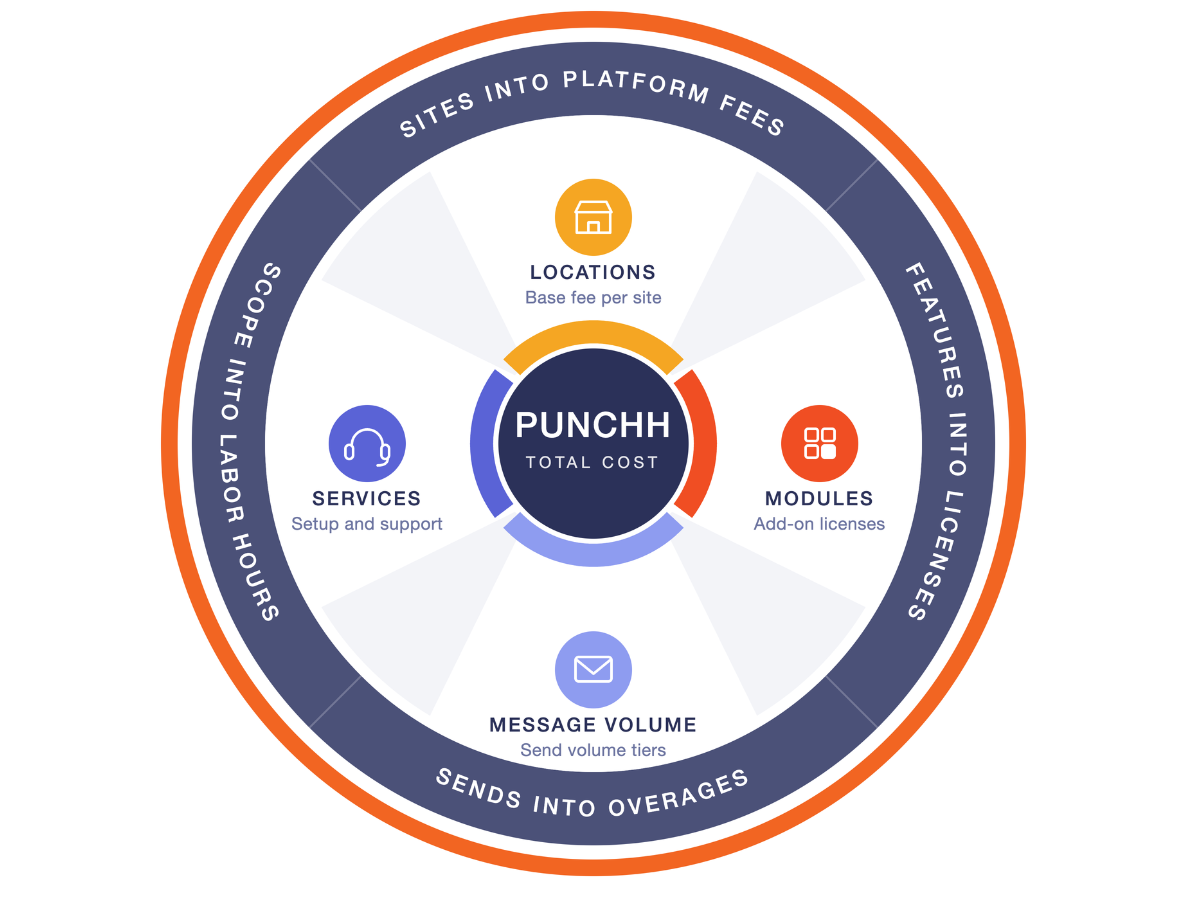
- Which modules you license. Additional Punchh capabilities and other PAR products can affect the overall contract. PAR also sells a number of Punchh capabilities as separately priced add-ons.
- Message volume. Email, SMS, and push volumes are recurring variable costs that scale with how aggressively you market.
- Services and execution support. PAR offers Managed Services for campaign execution and Strategic Consulting for program design and optimization, plus optional Guest Support Services to field member requests. These help lean teams operate at scale, and they add to the contract.
- App and digital experience packages. Branded app builds, wallet passes, app-less experiences, and ordering surfaces are scoped separately from the loyalty engine, and app updates are billed as separate monthly fees, with some contracts capping updates per year.
- Integrations. Punchh integrates with a broad set of POS, ordering, and marketing systems, but the number and complexity of connections in your stack affect both implementation cost and timeline.
- Engagement add-ons. Newer capabilities like gamification (PAR Games) are priced as additions, not included by default. PAR's documentation lists each of the following as available for an additional cost: Smart Passes, PAR Games, Challenges, Surveys, Coupons and Promos, Digital Stored Value with Gift Cards, Memberships, Loyalty Pay, Data Pipeline, Webhooks, and eClub.
Does Punchh Have a Free Plan?
No. Punchh does not offer a free plan, a free trial, or a self-serve tier. TrustRadius confirms no free version or trial is available, and every engagement runs through a contract quoted by PAR.
Two things get conflated here: guests join a brand's loyalty program for free, but the brand pays for the platform running it. The closest thing to a trial is a demo.
Is Punchh Worth the Investment?
By footprint, Punchh is one of the most proven loyalty platforms in the category. PAR reports that Punchh powers loyalty for more than 275 restaurant brands across 89,000 locations worldwide, with over 500 million loyalty members and roughly $2 billion in monthly loyalty transactions.
If enterprise references at scale matter to your evaluation, that box is firmly checked.
Customer sentiment across G2, Capterra, and TrustRadius is more mixed, and the patterns are consistent enough to be useful.
What reviewers praise: Customers give points to Punchh's segmentation and campaign capabilities that are deep enough that teams keep finding new strategies inside them. They also have positive sentiments about promotion management (particularly franchises), a dashboard that makes guest activity and check-ins easy to see, and its range of integrations.
What reviewers flag: Some describe a steeper learning curve, particularly when configuring rewards, campaigns, and segments. Others mention features going unused because they're hard to find or figure out; capabilities like games and wallets sitting outside the base price; and total cost that climbs with each module added. PAR's own Data Pipeline FAQ also addresses why there is a charge to access your own transaction data.
Some interface and reporting complaints come from older reviews, so weigh those against more recent releases.
That points to a fairly specific conclusion. Punchh is a strong fit for large enterprise brands with the marketing headcount, or the services budget, to operate a deep platform and actually use most of what they license.
For mid-market brands, the math is harder. Paying enterprise pricing for a system you only partially adopt is the fastest route to a loyalty program that costs more than it returns.
Exploring Alternatives to Punchh?
If the quote looks like more platform than your team will realistically use, Thanx is worth a look. It is a guest engagement and loyalty platform built for multi-location restaurant brands that want loyalty to drive measurable revenue rather than check an “I need a loyalty program to be competitive” box.
Cheba Hut is a useful benchmark: after moving from Punchh to Thanx, the fast casual chain grew loyalty revenue capture 2.65x and active member engagement 2.7x in less than one year.
Where it stands apart:
- One simple price, everything included. Pricing is per location and covers the platform, app updates, and every improvement Thanx ships, with no separate modules to buy, no per-update app fees, and no charge to access your data.
- Campaigns you can prove. A/B testing and control groups are part of campaign setup rather than a project, and they run on automations as well as one-time sends. Reporting shows purchasers, spend, campaign cost, and ROAS by variant. SegmentAI builds an audience from a plain-English description rather than a stack of rules set one at a time.
- Rewards that protect margin. Hidden Menus, Access Pass perks, bonus points, and modifier rewards give guests real exclusivity instead of blanket discounts. Thanx reports an effective discount rate of roughly 2.4% against an industry benchmark of about 10%.
- Loyalty built into fast first-party ordering. Modern web and mobile ordering with loyalty embedded in checkout, reaching 80 to 95% app conversion rates, so digital growth and data capture reinforce each other.
- Richer guest data without app friction. Enrollment built into first-party ordering means guests join without downloading an app or working through a long signup form, and brands moving off legacy platforms see 265% more sign-ups per location and 223% higher revenue capture.
- Proof in the dashboard. Reporting measures incremental lift alongside revenue, visit frequency, and customer lifetime value. Data export is included in the base price.
- A light lift to launch. Implementations average around 90 days, compared with the 9 to 12 months common in the category, with no hardware to install and the option to roll over an existing app.
The result is enterprise-grade capability for teams without enterprise-sized marketing departments, and ROI you can see in the dashboard instead of debating at renewal.
Curious what that looks like for your brand? Request a demo, and we will walk you through it.

.png)





.avif)
.avif)