


.avif)

Incentivio Pricing: Is It a Smart Investment for Your Restaurant?
You have narrowed your guest engagement shortlist down to a few platforms, opened a tab to check what Incentivio costs, and found a "Book a Demo" button where the pricing page should be.
That is a real problem when you are trying to build a budget. Without a published price, you cannot tell whether you are looking at a few hundred dollars a month or a five-figure annual commitment until you are several sales calls deep or have done some digging on your own.
A quick search of third-party review sites does give you a starting point. But that's only part of the bill. A deeper dive into Incentivio's own documentation shows a base platform fee plus additional charges tied to transactions, delivery, and SMS usage. So you're left wondering what the platform will actually cost at your volume and scale.
This guide puts those pieces together so you can understand what Incentivio starts at, what costs drive the final cost, and whether the investment makes sense for a restaurant like yours.
How Much Does Incentivio Cost?
Incentivio does not publish pricing. There is no pricing page in its navigation, and every call to action on the site routes to a demo request instead. Its G2 profile reflects the same thing: no pricing information has been provided, so buyers are directed to contact the vendor. If you want a real number for your brand, you have to talk to sales.
That doesn't mean we're starting from zero, though. Incentivio maintains a vendor listing on the restaurant technology marketplace Back of House, which lists a Standard Plan at $249 per month plus setup fees. The same starting figure appears on Capterra and Software Advice, both of which list a "Basic" tier as a flat monthly rate.

Source: snapshot of Incentivio’s profile page on Software Advice
For a smaller multi-unit brand, that starting price can be attractive, but it's best to treat that $249 as a floor rather than a forecast. It is only the starting point for the smallest possible configuration, and it excludes the setup and onboarding investment that comes with a branded app and POS integration. Incentivio's own billing documentation shows that the base platform fee is only one part of the bill.
It also helps to know where Incentivio sits in the market. It positions itself as a guest engagement platform built for multi-unit brands, "designed for scale, not single-location hacks or enterprise bloat."
That puts its entry point in a similar range to other mid-market focused tools for brands with limited digital ordering volume but costly as you scale up and digital ordering volume grows. Back of House also advertises partner discounts on both the subscription and the setup fee for new customers, which suggests there is room to negotiate.
Incentivio's Commission-Free Subscription Model
Incentivio markets its ordering and delivery as commission-free. Instead of paying a percentage of every first-party order, you pay a recurring subscription and keep the revenue.
That distinction matters, but commission-free is not the same as flat. Incentivio's own invoice documentation describes a hybrid model: a fixed base platform fee billed in advance, plus three variable meters billed in arrears for transaction fees, delivery fees and tips, and SMS. None of those is a percentage of revenue, but all three rise with volume, so your platform bill still grows as your digital business grows.
The trade-off is that the base fee is a fixed cost you pay whether or not your digital order volume justifies it, while the variable meters make the total harder to forecast the more successful the program becomes. The model favors brands with real first-party volume or a credible plan to build it, and a clear view of what the meters will add at that volume.
Factors Affecting Incentivio Pricing
Because Incentivio uses a hybrid model, two brands of the same size can land on very different numbers. These are the variables that move the price:
- Number of locations. Multi-unit and franchise rollouts scale the subscription and lengthen implementation. Opening a new location also runs on Incentivio's lead time, about two weeks, and is requested by email.
- Which parts of the platform you license. Incentivio organizes its product into three layers: Commerce (digital ordering, white-label mobile apps, dispatch, wallets and gift cards), Engagement (loyalty, marketing automation, CRM, guest journey), and Intelligence (churn management, upsell recommendations, menu intelligence, Incentivio Connect, and Loyalty Pulse ROI reporting). Licensing the full stack costs more than licensing ordering alone.
- Message volume. SMS is metered. Incentivio's published rate card is $0.03 per message segment, and it applies to marketing texts, account verification, guest checkout verification, and passwordless sign-in, not just campaigns. The only free texts are order confirmations, plus order complete notifications on Toast. Because billing is per segment rather than per message, a single emoji drops the limit from 160 to 70 characters and can double the cost of a send. Passwordless login is the line to watch: a brand with 50,000 monthly logins pays $1,500 a month for guests to sign in, and by default those charges are split evenly across locations regardless of where the messages went.
- Setup and onboarding fees. These sit on top of the subscription. Back of House describes Incentivio's onboarding as white-glove, covering everything from branding through launch, which is valuable but not free.
- Mobile app customization. A more heavily customized white-label iOS and Android app takes more configuration than a standard template build. Budget for changes after launch too. There is no content management system for the app, so home screen changes ship as app releases through TestFlight and app store review, and adding something as small as a gift card button takes one to two weeks.
- Integrations. Incentivio connects to POS systems including Toast, Square, Lightspeed, PAR Brink, Revel, SpotOn, and Qu, along with payment processors and delivery providers. The number and complexity of the systems you need connected affect implementation scope. What you get also depends on which POS you run. Calorie and nutrition display, native gift cards, and in-app payment are Toast-only, and SpotOn brands get no in-store offer redemption at all, so confirm what is supported on your POS before you compare quotes.
- Costs outside the Incentivio invoice. Toast charges its own monthly integration fee before any integration can be added, brands on Square Loyalty pay Square separately per loyalty visit, and pooling gift card funds across locations requires a separate payment processor because Toast does not permit Toast Payment Processing for that purpose.
[IMAGE: Simple graphic or table illustrating the cost drivers above]
The practical effect is that Incentivio tends to look most affordable at launch. As locations, orders, delivery volume, and guest messaging grow, the variable meters grow with them, and somewhere around seven to ten locations the total typically overtakes a flat, per-location subscription. The number to compare across vendors is not the base fee but the twelve-month total at your projected volume.
Does Incentivio Have a Free Plan?
No. Incentivio does not offer a free plan or a self-serve tier, and Capterra confirms there is no free version and no free trial. It is a contracted platform priced by quote.
One distinction worth making clear, since it trips people up: your guests join your loyalty program for free. The brand pays for the platform that powers it. If you want to evaluate the platform before committing, Incentivio offers a demo rather than a trial account.
Is Incentivio Worth the Investment?
For the right brand, the value case is straightforward. Incentivio bundles first-party ordering, loyalty, guest data, and marketing automation into a single contract, which removes the integration tax of running separate ordering and loyalty vendors. It still sits on top of your POS, so you are managing two vendor relationships rather than one, but that is fewer than a patchwork stack.
That all-in-one convenience is the core of their pitch, and it is genuinely useful for lean teams. Incentivio reports serving more than 4,600 restaurants and processing over 200 million orders annually, with brands including Huey Magoo's, Everbowl, and Port City Java.
Sentiments across the four reviews on Capterra and one on G2 back this up. Incentivio earns consistent praise for an intuitive interface, responsive and hands-on support, useful guest data and analytics, and the convenience of running ordering, loyalty, and marketing in one place.
Reviewers who came from a patchwork of separate tools single out how much simpler it is to manage on a unified platform.
So the answer comes down to fit and priority. If what you need is to consolidate vendors and get a branded digital experience live, and you are small enough that the transaction and SMS meters stay modest, Incentivio is built squarely for that, and the math likely works.
If your priority is proving that loyalty drives incremental revenue, running deeper segmentation and personalized marketing, or layering in control-group testing, it is worth comparing an all-in-one bundle against a platform built specifically for that job.
Exploring Alternatives to Incentivio?
If measurable, margin-friendly growth is the outcome you are buying, Thanx is worth a look. It is a guest engagement and loyalty platform built for multi-unit restaurant brands that want loyalty to function as a revenue channel rather than a cost line.
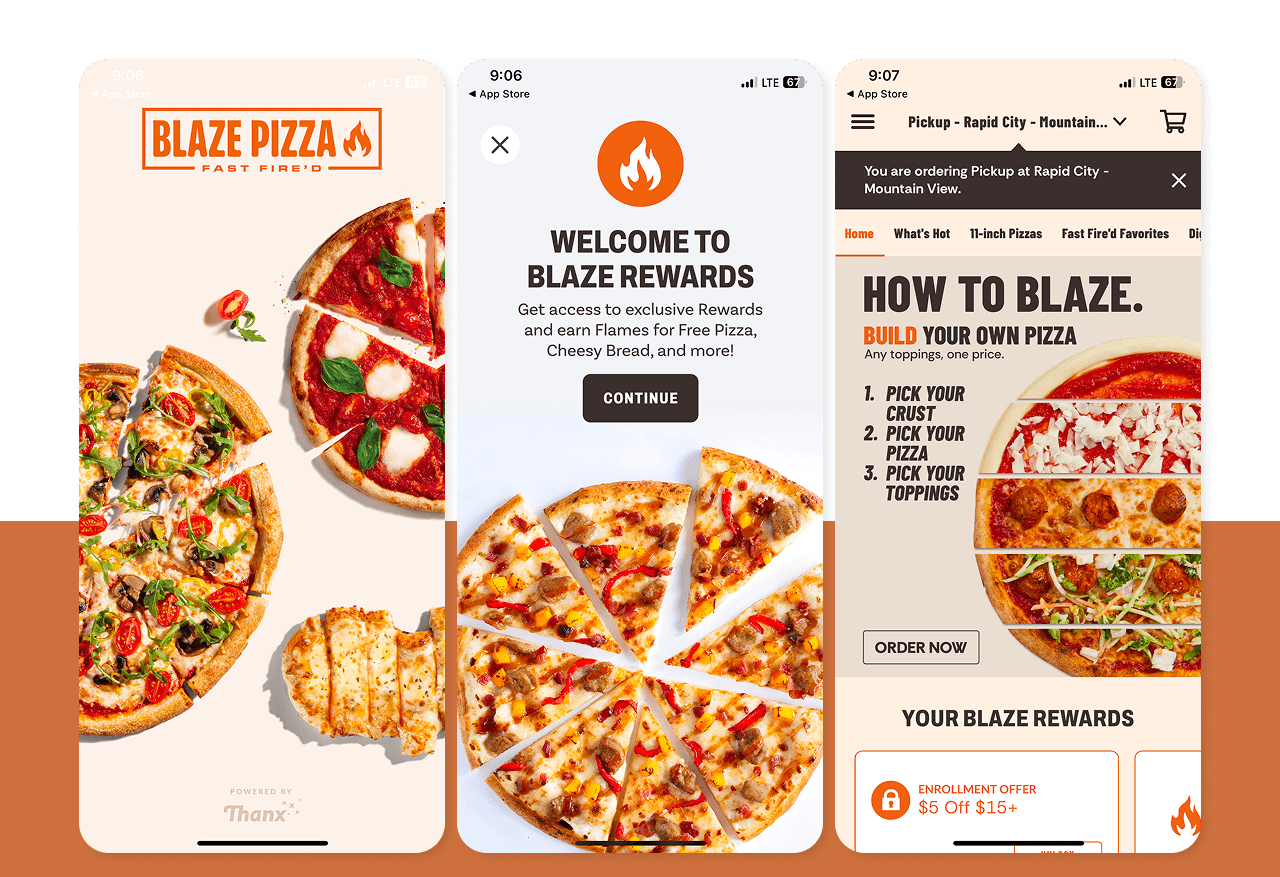
Pokeworks is a good example of what that looks like. Within seven months of launch, the fast casual chain had quadrupled loyalty signups and grown loyalty into a double-digit share of sales, without leaning on discounts to get there.
- Personalized rewards that protect margin. Beyond standard discounts, Thanx supports non-discount rewards like secret menus, VIP access perks, and bonus points. Brands using Thanx typically cut their effective discount rate from a category-typical 8 to 15 percent down to roughly 2.4 percent.
- Loyalty built into fast first-party ordering. Passwordless web and app ordering with loyalty embedded in the checkout flow, delivering 80 to 95 percent app conversion rates and an average 35 percent lift in repeat visits.
- Richer guest data and segmentation. Frictionless enrollment drives 300+ sign-ups per location per month and 30%+ data capture within six months, producing 57% more purchase data than standard programs to target against.
- Marketing automation a lean team can actually run. Build audiences with SegmentAI, which uses plain-English prompts to create segments from 400+ guest attributes, then put those audiences to work across email campaigns, automated lifecycle journeys, and A/B tests with control-group variants.
- ROI you can prove in the dashboard. Reporting isolates true incremental lift, so you can show leadership what loyalty actually generated rather than reporting sign-up counts.
- Fast, low-lift implementation. Around 90 days on average, with no hardware to install, an app roll-over so guests do not download anything new, and 60+ prebuilt integrations across POS, ordering, feedback, CDP, and kiosk systems.
- Flexible POS and ordering integrations. Thanx connects directly to POS systems including Toast and Square, and works with Olo and Deliverect where a brand already runs ordering middleware, with consistent capability across all of them. That gives brands the flexibility to keep the systems that already work for them while adding loyalty and guest engagement on top.
The result is a modern platform lean teams can run day-to-day, tied to the metrics your CFO cares about: first-party digital revenue, visit frequency, and customer lifetime value.
Want to see what that looks like for your brand? Request a demo, and we will walk you through it.

.png)




.avif)
.avif)