
.png)

.avif)

The Wrong Reward for the Right Guest Is Still the Wrong Reward
Here's the mistake most restaurant loyalty programs make: they treat a first-time visitor the same as a guest who has spent $2,000 over three years. Same offer, same message, same incentive regardless of the guest's history, value, or what it would actually take to change their behavior.
The result is a program that over-rewards guests who don't need persuading, under-invests in guests who do, and bleeds margin without driving the behavior changes that justify the cost.
Matching rewards to guest segments is how you fix this. Different guests are at different stages of their relationship with your brand and each stage calls for a different type of incentive, calibrated to the value of that guest and the size of the behavioral shift you're asking for.
This guide shows you exactly how to think about reward value by segment, what benchmarks to use, and how leading restaurant operators build reward strategies that protect margins while genuinely strengthening guest relationships.
How It Works: Five Principles for Reward-Segment Matching
1. Revenue Is Concentrated. Your Rewards Should Reflect That
Before designing any reward structure, understand where your revenue actually comes from. Research consistently shows that roughly 25% of guests generate approximately 70% of total revenue. Losing one high-value guest can equal losing ten occasional visitors in revenue impact.
This means a one-size-fits-all reward program is economically irrational. Spending the same amount to retain a $2,000-per-year guest as you spend on a $50-per-year visitor isn't equitable, it's wasteful. Your reward investment should scale with guest value.
2. Your Intro Offer's Job Is Visit Two, Not Visit One
New members are already in your database. The goal of your welcome offer isn't just acquisition, it's habit installation. Specifically, getting a guest to return for a second visit, which puts them on a path toward the third visit where lifetime value inflects dramatically.
Guests who make a third purchase are roughly 10–12x more valuable over their lifetime than one-time visitors. This makes new member reward design one of the highest-leverage decisions in your entire loyalty program.
The most common mistake: offering a large discount that delivers full value on the first visit with no return behavior required. A better approach is an intro offer calibrated to generate visit two, enough to create a pull, not so much that it subsidizes a guest who would have come back anyway.
3. Match Reward Value to Segment Value
A practical framework for calibrating reward size by segment:
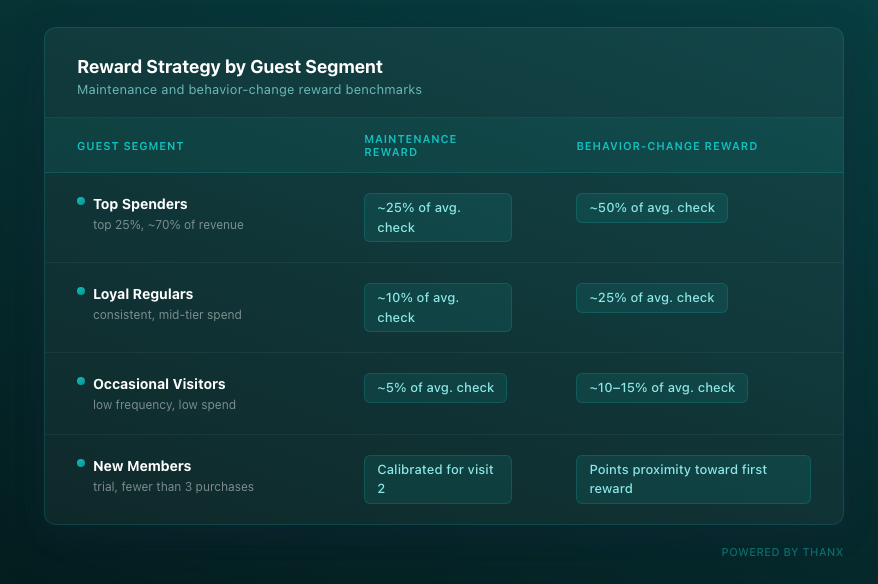
"Maintenance" means keeping guests happy and engaged at their current behavior. "Behavior-change" means asking them to do something meaningfully different like visit more often, come during a different daypart, try a new channel, or increase their average spend.
The bigger the ask, the bigger the reward needs to be.
4. Design Your Rewards Marketplace for Two Types of Guests
Any loyalty member base contains two fundamentally different reward personalities and a well-designed rewards marketplace serves both:
Quick redeemers want frequent small wins. They stay engaged through regular, accessible rewards. High redemption thresholds feel out of reach and cause disengagement. For this group, having a low-tier reward attainable in one or two visits is essential.
Savers want an aspirational goal. Accumulating points toward something meaningful gives your loyalty currency long-term value. For this group, the existence of a premium reward worth working toward is what keeps the program compelling over time.
A program designed for only one type will underperform with the other. A three-tier reward marketplace like an accessible entry-level reward, a mid-tier option, and an aspirational premium reward serves the full spectrum of your member base.
5. Use Multi-Use Rewards to Build Habits, Not Just Transactions
Single-use rewards drive a visit. Multi-use rewards build patterns.
Offering a recurring reward like a complimentary upgrade available twice a week for a month, a free add-on every Friday for a defined period, or a daily discount available for a limited window creates a sustained reason to return across multiple visits. Instead of one redemption, you get a series of reinforced behaviors that compound into habit.
This is particularly powerful for new members in the activation window and for guests you're trying to pull toward a higher visit frequency tier.
Real-World Examples: Reward Strategy in Action
Example 1: Protecting High-Value Guests Without Over-Discounting (Casual Dining Group)
A multi-unit casual dining brand identified that their top 20% of loyalty members were responsible for nearly 65% of loyalty revenue. This group was visiting regularly and spending well. They weren't at risk of leaving, but they weren't receiving any recognition that differentiated them from the broader member base.
Rather than offering larger discounts (which these guests didn't need to stay loyal), the brand introduced a VIP tier with non-discount rewards: priority reservations on weekends, access to a hidden menu item available only to members, and an exclusive invitation to a quarterly tasting event.
The cost to deliver these perks was significantly lower than an equivalent dollar-off discount. The perceived value to guests was higher. Retention among the VIP segment improved measurably. Word-of-mouth from this group, or guests who now had something exclusive to talk about, increased organic acquisition at no additional cost.
Example 2: Engineering the Path from Trial to Regular (Fast Casual Chain)
A fast-casual chain rebuilt their new member reward sequence around a single insight: the goal isn't visit one, it's visit three.
Rather than offering a large welcome discount redeemable on the first visit, they redesigned the intro offer as a points proximity bonus: new members received enough bonus points to put them close to, but not at, their first reward threshold. The reward was visible, attainable, and required one return visit to unlock.
After the first redemption, a second automated nudge arrived, pointing to the next reward in the marketplace and showing the guest how close they were. By the third visit, the habit loop was established, and the brand had spent significantly less on discounts than their prior welcome offer structure required.
Example 3: Filling Slow Periods Without Cannibalizing Peak Hours (Regional Coffee Brand)
A regional coffee concept wanted to drive afternoon traffic during a chronically slow 2–5pm window without touching their profitable morning rush. They used time-restricted, value-scaled rewards targeted specifically at their mid-tier loyal regulars or guests who visited frequently but almost exclusively in the morning.
The offer: a recurring free modifier (oat milk, specialty syrup, extra shot) available exclusively between 2pm and 5pm, redeemable twice per week for 30 days. The value was calibrated at roughly 20–25% of the target segment's average check which was meaningful enough to prompt a behavior change, low enough to protect margins.
Afternoon traffic from enrolled members in the target segment increased meaningfully during the campaign period, and a portion of those guests maintained afternoon visits after the multi-use reward expired because the habit had formed.
Best Practices: What Separates Strategic Rewards from Expensive Guesswork
Calibrate to behavior change, not just generosity. The most common mistake is choosing reward values based on what feels good rather than what the specific behavior change is worth. Rewarding existing behavior requires a small token of appreciation. Asking a guest to change an established pattern requires a meaningful incentive. Conflating these leads to either over-spending or under-delivering.
Don't apply win-back rewards to guests still in the activation window. New members with fewer than three purchases enrolled within the past 120 days are not lapsing — they're still forming a habit. Treating them as churned guests with heavy discount win-back offers misreads the signal and wastes spend. Exclude this cohort from lapse and win-back flows.
Non-discount rewards reduce EDR without reducing satisfaction. Exclusive experiences, early access, hidden menu items, and VIP perks often cost less to deliver than discount rewards while generating equal or higher guest satisfaction, particularly among your highest-value segments.
Use progressive value scaling in your marketplace. If your entry-level reward delivers $5 in value, your premium reward should deliver proportionally more, not just a marginally larger discount. Progressive scaling encourages guests to save for higher-tier redemptions, which typically carry better perceived value and lower actual cost to your business than many small redemptions.
Getting Started: Building a Segment-Matched Reward Strategy
Begin by answering three questions about your current program:
- What percentage of your loyalty revenue comes from your top 25% of guests? If you don't know, that's the first data gap to close.
- What is your new member conversion rate from visit one to visit three within 120 days? This tells you how well your intro offer is installing the habit you need.
- What is your effective discount rate? This tells you where your reward dollars are actually going versus where they should be.
With those answers in hand, you can prioritize which segment-reward relationships to fix first and set a clear benchmark for improvement.
With Thanx, reward calibration by segment is built into the platform. Pre-built lifecycle segments, configurable reward values, multi-use reward structures, and real-time performance reporting give operators the data and tools to run a reward strategy that earns its cost without requiring a marketing analyst or a developer to maintain it.
Want to see how Thanx helps you match rewards to the right guests? Request a demo.
Frequently Asked Questions About Loyalty Reward Strategy by Segment
How should restaurants choose rewards for different customer segments?
Reward value should scale with guest value and the magnitude of behavior change being requested. Top spenders warrant rewards worth approximately 25% of average check size for retention, and up to 50% when requesting a significant behavior shift. Loyal regulars respond well to 10% maintenance rewards. Occasional visitors need only 5% of average check to maintain engagement. Matching reward generosity to guest value and behavioral ask is what keeps effective discount rates low while driving real outcomes.
What is the most important reward to get right in a restaurant loyalty program?
The new member intro offer. Its job is to generate a second visit, not reward the first. Programs that offer large welcome discounts redeemable on visit one deliver value upfront with no return behavior required. The highest-leverage design is an offer calibrated to pull guests back for visit two, putting them on the path toward visit three, where lifetime value is roughly 10–12x that of a one-time buyer.
What is a rewards marketplace in a loyalty program?
A rewards marketplace is a digital catalog where loyalty members can browse and redeem available rewards using their points balance. An effective marketplace offers rewards at multiple tiers i.e. accessible entry-level options for quick redeemers, mid-tier choices, and aspirational premium rewards for guests who prefer to save so it serves the full range of guest engagement styles.
What are non-discount loyalty rewards, and when should restaurants use them?
Non-discount rewards include exclusive experiences, VIP access, hidden menu items, priority reservations, and partner perks, delivering guest value without a direct price reduction. They're most effective for high-value guest segments where relationship depth matters more than transactional savings. Non-discount rewards typically cost less to deliver than equivalent discount rewards, making them a powerful tool for reducing effective discount rate while maintaining or improving guest satisfaction.
How do multi-use rewards differ from single-use offers?
Single-use rewards drive one visit or transaction. Multi-use rewards are a recurring perk available multiple times per week over a defined period and create a sustained reason to return across multiple visits. This helps build habitual behavior rather than a one-time transaction. They're particularly effective for new member activation and for guests being moved toward higher visit frequency.
Ready to see what business outcomes you can achieve with Thanx? Request a demo.
Popular guides and tutorials
.avif)
.avif)