
.png)

.avif)

What Every Restaurant Operator Should Understand about Points-Based Loyalty
Points-based loyalty programs reward guests with accumulating points for every qualifying purchase, which they can redeem for discounts, free items, or exclusive experiences in a configurable digital marketplace. When designed well, they drive repeat visits, increase average check size, and give operators precise control over discount exposure without sacrificing the guest experience.
Here's everything you need to know about how they work, how to configure them for maximum ROI, and why the structure of your points program matters more than most operators realize.
How a Points-Based Loyalty Program Works
At its core, a points program operates on a simple principle: guests earn points with every qualifying purchase and exchange those points for rewards. The simplicity for guests, combined with deep configurability for operators, is what makes it the most widely adopted loyalty structure in the restaurant industry.
- Earning Points: Guests automatically collect points whenever they make a tracked purchase with no card scanning or manual check-ins required. Conversion rates are typically straightforward: $1 = 1 point, or $1 = 10 points. Both deliver the same economic value, but the psychological impact differs. Higher ratios make accumulation feel faster, which is particularly effective for lower average-check concepts like coffee or fast casual.
- The Rewards Marketplace: Guests view their balance and browse available rewards through a mobile app or web ordering experience. Unlike traditional loyalty programs with one or two fixed rewards, a points marketplace offers multiple options at different point thresholds. This gives guests a choice and creates a sense of progression. The best marketplaces mix discount-based rewards (dollars off, free items) with non-discount rewards (exclusive experiences, early access, partner perks) to maximize perceived value while managing cost.
- Real-Time Operator Control: With Thanx, operators manage every element of the rewards marketplace directly from their dashboard, adding rewards, adjusting point costs, updating imagery, and toggling availability. All without technical overhead or developer support. This real-time control is what separates modern platforms from legacy systems, where reward changes required a support ticket and a waiting period.
Ways to Award Points Beyond Purchases
Purchase-based earning is the foundation, but the most effective points programs create additional earning moments that deepen the guest relationship and shape behavior.
- Welcome Bonuses: Award new members enough bonus points to get close to their first reward, but not quite there. This creates a concrete pull for the second visit: guests know exactly what they're working toward. Welcome bonuses outperform flat dollar-off intro rewards precisely because they require a return visit to realize value, building the habit from day one.
- Birthday Rewards: Birthday points feel personal and celebratory, creating an emotional connection during a moment that matters. For best results, send the birthday reward seven days before the guest's birthday with a 14-day redemption window. This gets your message into the inbox before competitor birthday emails arrive.
- Campaign-Based Bonus Points: Run targeted campaigns that award bonus points for specific behaviors or periods: double points during slow days, bonus points for trying new menu items, or extra points for guests who haven't visited recently. These campaigns let you pursue specific business objectives while rewarding engagement without the permanent margin exposure of a blanket discount.
.png)
Configuring Your Marketplace for Maximum ROI
Set the Right Points Values
Choose points values for rewards that makes accumulation feel meaningful without undermining your margins. The math matters: if your average check is $25 and guests earn 1 point per dollar, your entry-level reward should cost approximately 25 to 30 points. This quick first win is critical — a guest who redeems once is far more likely to keep earning and redeeming than one who never gets there.
Design With the Third Purchase in Mind
The third purchase is where loyalty behavior becomes habitual. Data from QSR programs shows that guests who make a third purchase are roughly 12x more valuable over their lifetime than first-time visitors. A small lift in third-purchase conversion has a near 1:1 correlation with same-store sales growth. Your early earn structure should be designed with this in mind: the goal isn't just a second visit, it's getting guests to that third purchase within 120 days.
Build a Progressive Reward Ladder
Offer at least three to five rewards at different point levels. Some guests want quick wins; others will save for premium options. More importantly, use progressive value scaling: if 10 points delivers $5 in value, 30 points should deliver $30 in value, not $15. Progressive scaling encourages guests to save for larger redemptions, which typically carry lower effective cost to your business while feeling more rewarding to guests.
Mix Discount and Non-Discount Rewards
Non-discount rewards including exclusive experiences, early access to new products, behind-the-scenes moments, and partner perks, provide compelling value to guests without touching your margin. When guests choose experiences over discounts, you maintain revenue while delivering differentiated value that generic loyalty programs can't replicate.
Understanding and Managing Your Effective Discount Rate
Your effective discount rate (EDR) is the percentage of loyalty revenue you return to guests through rewards. It's one of the most important metrics for evaluating loyalty program health and one of the most overlooked.
For most well-run programs, a healthy EDR is 3% or below. Legacy loyalty platforms commonly run at 10–12%, meaning brands are returning a significant chunk of loyalty revenue in discounts, often without driving proportional behavior change. Thanx brands average 2–2.5%. That gap represents real margin and it compounds at scale.
How does a points program keep EDR in check?
- Not all earned points are redeemed. Breakage is built into the model.
- Non-discount rewards. Shifting redemption toward experiences reduces the direct revenue impact of your loyalty investment.
- Progressive scaling. Structuring higher-tier rewards to be proportionally more attractive encourages fewer, higher-value redemptions over frequent small ones.
If your EDR climbs above 5%, it's worth auditing your reward structure. High-friction programs typically require larger discounts to drive participation. Low-friction platforms like Thanx engage guests at a fraction of the cost.
Real-World Points Program Benchmarks by Segment
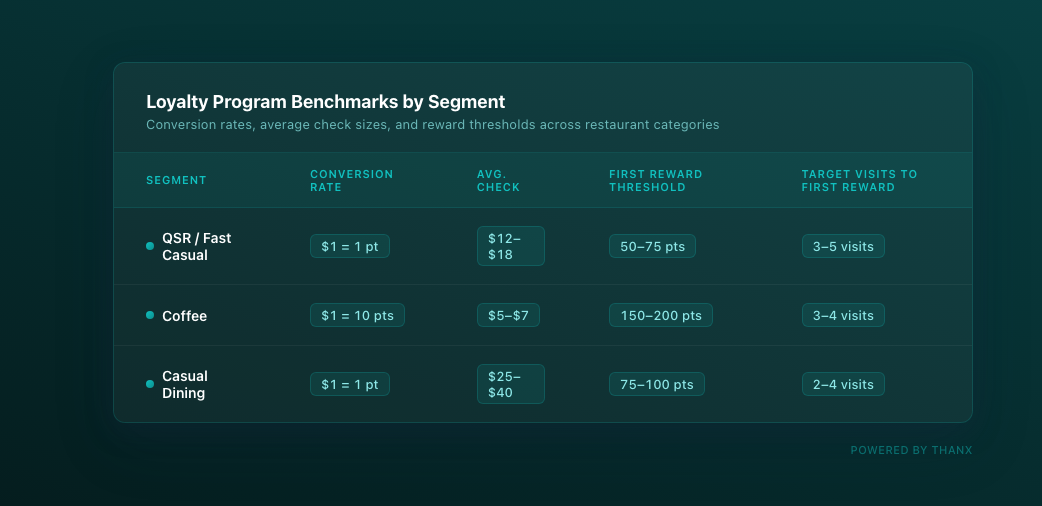
These are starting benchmarks, not prescriptions. Because Thanx allows real-time configuration, operators can test conversion rates, adjust reward thresholds, and respond to redemption patterns without waiting on a support queue. This helps treat the program as a continuous optimization engine rather than a set-and-forget system.
Frequently Asked Questions About Points-Based Loyalty Programs
What is a points-based loyalty program?
A points-based loyalty program is a customer retention system where guests earn points for qualifying purchases and redeem them for rewards. Points accumulate in a digital account and can be exchanged for discounts, free items, or exclusive experiences through a configurable rewards marketplace.
How do points programs increase restaurant revenue?
Points programs increase revenue by driving repeat visit frequency, raising average check size, and reducing churn. Guests enrolled in points-based loyalty programs visit significantly more often than non-enrolled guests and tend to spend more per visit, particularly when targeted with behavior-based offers.
What is an effective discount rate in loyalty programs?
Effective discount rate (EDR) is the percentage of loyalty revenue returned to guests through rewards. A well-run points program should maintain an EDR at or below 3%. Thanx brands average 2–2.5%, compared to 10–12% on legacy platforms.
How is a points program different from a punch card?
Punch cards reward transactions, but generate no data or insight. A digital points program automatically identifies guests, builds behavioral profiles, enables targeted marketing campaigns, and provides analytics. This gives operators the ability to act on what they know rather than guess.
How does Thanx handle points program configuration?
Thanx gives operators real-time control over elements of their points program through a merchant dashboard including conversion rates, reward costs, marketplace imagery, availability windows, and bonus point campaigns. No technical overhead or need for developer support.
What types of rewards should a points program include?
Effective points marketplaces include a mix of discount-based rewards (free items, dollars off) and non-discount rewards (exclusive experiences, early access, partner perks). Non-discount rewards provide high perceived value to guests while protecting operator margins.
The Bottom Line: Points Programs That Pay for Themselves
A points program structured around guest behavior, progressive value, and real-time operator control doesn't just reward loyalty. It creates it. The difference between a program running at a 10% EDR and one running at 2.5% isn't just margin recaptured. It's the difference between a loyalty program that subsidizes behavior that would have happened anyway and one that actively shapes the habits of your best guests.
Thanx-powered points programs give operators the configurability to start smart, the data to optimize continuously, and the flexibility to respond to market conditions without waiting on a vendor.
Ready to see what a well-configured points program looks like for your brand? Request a demo
Popular guides and tutorials
.avif)
.avif)